
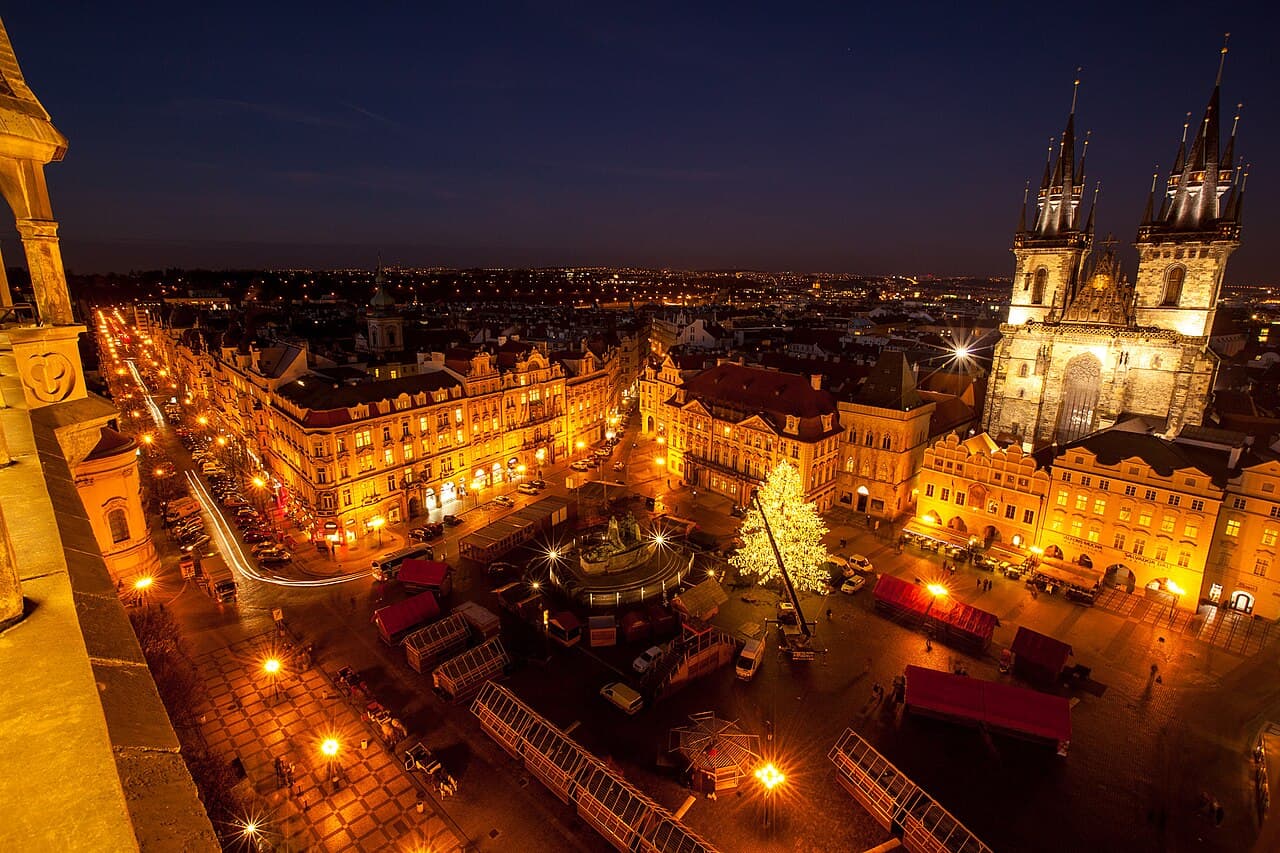

The New Year’s corporate party in Prague is being planned based on the date: in 2026, the last workday before the holidays falls on Wednesday, December 23. The budget and format are selected based on the chosen evening. Employees do not pay a participation fee for such an event, but the company will not be able to write off these expenses.
When should you book a New Year’s corporate party?
The Vélour Agency, which organizes corporate parties, provides specific dates for Prague: it advises contacting venues in September or October. The agency considers the period from mid-December through the 20th to be the busiest, especially Wednesdays and Thursdays, and says that venues in the city center for these evenings are booked up several months in advance. This is the observation of a single agency; there are no market statistics to back it up.
On the 2026 calendar, this period falls on Wednesday, December 16, and Thursday, December 17. If there are no December evenings left, a New Year’s corporate party can be held in January.
If you’re reading this in November 2026, inquire with venues about weekday evenings in the first half of December and, at the same time, keep a January date in reserve.
Holidays on December 24–26 and the 2026 calendar
According to Law No. 245/2000 Sb. Štědrý den (Christmas Eve, December 24), 1. svátek vánoční (December 25), and 2. svátek vánoční (December 26) are public holidays and, therefore, days off from work.
In 2026, December 24 falls on a Thursday. Together with the weekend, this results in four consecutive days off, from December 24 through 27, and the last workday before them is Wednesday, December 23. January 1, 2027, which is also a holiday, falls on a Friday.
Stores with a retail area of more than 200 m² close at 12:00 p.m. on December 24 and remain closed all day on December 25 and 26—as required by Law No. 223/2016 Sb. There are exceptions: pharmacies, gas stations, and stores at train stations, airports, and hospitals. This ban does not apply to restaurants, as it concerns only the sale of goods, and each establishment decides independently whether to operate on holidays. The dates of all holidays are listed on the page for holidays and days off in the Czech Republic.
How much does a New Year’s corporate party cost, and what does the budget include?
There is no set price for a corporate party. It’s easier to draw up a budget by expense category and ask the contractor to list each one separately:
- venue—hall rental (pronájem sálu) or minimum spend (minimální útrata), i.e., the amount guests must spend to have the hall reserved exclusively for your event;
- food and drinks — a set menu per guest or a buffet (raut);
- program and equipment — emcee, DJ, performers, sound, lighting, and microphones;
- decor, photography, and transportation, including taxis after the event;
- the event planner’s fee, if you hire one.
 Photo: Dragon White Munthe / Unsplash, Unsplash License
Here’s an example from one venue to illustrate what the minimum bill looks like in numbers: PUB 88 in the Záběhlice district (Prague 10) states on its website that it will close the entire venue for a single group at no rental fee if the bill totals at least 20,000 Kč, and the venue can accommodate up to 50 guests. This is just one example; other venues have their own terms.
In every quote from a contractor, make sure to clarify whether the price is listed with DPH (including value-added tax) or without DPH (excluding it).
If a restaurant or catering service is a VAT payer, the December invoice will list two rates. Food is taxed at a reduced rate of 12%. Most beverages, whether soda or wine, are taxed at the standard rate of 21%: in 2026, the reduced rate for beverages will apply only to drinking water, milk, dairy beverages, and their plant-based alternatives (§ 47 and Annex No. 2 to the VAT Act).
Starting January 1, 2027, the rules change: according to Act No. 180/2026 Sb., all non-alcoholic beverages served in restaurants and during catering events will be taxed at a rate of 12%, while the 21% rate will apply only to alcoholic beverages. The VAT calculator will help you convert the estimate in both directions, and if the budget is approved by headquarters in euros, you can conveniently check the amounts using a currency converter.
On Your Own or With an Agency—Who’s Responsible for What
A dinner for a small team at a restaurant with a set menu is organized by a single designated employee. An event agency pays off when there are many contractors involved: the venue, catering, equipment, a host, and transportation. Other reasons to use an agency include off-site events, partner guests, or a team where no one speaks Czech.
The agency takes full responsibility for organizing the corporate event: the concept and program, selecting the venue and vendors, contracts, timing, and coordination on the day of the event. Prices are listed in the published price list: corporate event planning in Prague by Vélour Agency starts at 15,000 Kč; quotes are calculated based on the specific event, and there are no pre-packaged options.
Ask any event planner how they make money: through a fixed fee or by marking up contractors’ invoices. Their answer will determine whether an expensive venue is profitable for them.
Before paying a deposit, check the venue or agency using a business verification service. Using the IČO (company identification number), the service will display data from the ARES state registry: the name, address, date of establishment, and information on whether the company is active. In the contract, pay attention to what’s included in the price, when and how much to pay, what happens in case of cancellation, and what happens if fewer guests show up than expected.
Where to hold the corporate party—at a restaurant, on a boat, or at a villa?
The venue is chosen based on the number of guests and how they’ll be getting home afterward.
- A restaurant or a private room. This is the simplest option, especially for a small group. Ask if they’ll close off the entire room and under what conditions: a rental fee or a minimum bill.
- A riverboat on the Vltava River. The time spent on board is fixed, so the program is tailored to the departure and return to the pier.
- A villa, castle, or country estate outside the city. You’ll need round-trip transportation. If the celebration turns into an overnight trip, discuss this with your accountant in advance: vacations and trips (rekreace, zájezd) have their own tax rules.
 Photo: Kaan Yener / Unsplash, Unsplash License
You can avoid renting a venue by using an office with catering, but you’ll be responsible for the furniture, dishes, equipment, and cleaning. And if the team wants to spend the whole day together, you can organize a team-building activity during the day and a dinner in the evening.
Do you have to pay taxes on a company party for employees?
Employees do not. This is explicitly stated in the Income Tax Act: according to § 6, paragraph 9, letter g), the participation of an employee and their family members in a celebration organized by the employer for a limited group of people is exempt from taxation. The law refers to such an event as a “společenská akce” (social event), specifically one featuring a cultural or sporting program. It must be a customary event for the company, and its format and scale must be proportionate. There is no limit on the amount eligible for this exemption.
In its guidance on tax benefits, the Financial Service cites Christmas parties, company anniversaries, and children’s days as examples and clarifies the conditions:
- the organizer is the employer itself, but an agency or other professional contractor may be hired to handle the preparations;
- the guest list is limited to employees, their families, and, if desired, business partners—that is, the event is “invitation-only”;
- A celebration held once or twice a year falls within these parameters, while weekly parties or vacations in exotic countries are generally not permitted.
The limited guest list must be documented: keep a record of the guest list and the invitation mailings, as the finance department considers these to be evidence. Social security and health insurance contributions are also not paid on exempt income: their base includes only taxable income (§ 5 of Act No. 589/1992 Sb. and § 3 of Act No. 592/1992 Sb.).
Holiday events do not reduce the company’s income tax. According to § 25, para. 1, letter h), expenses for employee benefits, including those for holidays, are not recognized as tax-deductible, and food and beverages, moreover, are considered entertainment expenses (reprezentace, letter t). There is also no VAT deduction for refreshments: § 72(6) of the VAT Act prohibits it for entertainment expenses.
The event can be paid for from the social fund (sociální fond), if the company has established one; in state organizations, the FKSP (fond kulturních a sociálních potřeb) serves the same purpose. The source of funds does not affect the outcome.
For the celebration in 2026, the situation is as follows:
| Scenario | Employee | Company |
|---|---|---|
| Holiday for employees and their families | No tax or contributions are paid; there is no limit (§ 6, para. 9, letter g) | The expense does not reduce tax (§ 25, para. 1, subpar. h and t) |
| Business partners at the same celebration | — | Entertainment expenses; do not reduce tax liability |
| Tickets to a concert or performance organized by another entity | tax-free within the overall limit of 24,483.50 Kč for 2026 (§ 6, para. 9, letter d) | expenses are not taxable within the limit |
| Gift to an employee | is subject to tax and social security contributions | not subject to tax; this is a gift (subparagraph t) |
The limit of 24,483.50 Kč is half of 48,967 Kč: according to the ČSSZ (Czech Social Security Administration), this is the average wage (for insurance purposes) in 2026. It is precisely this figure that the tax law uses as the basis for the limits (§ 21g), so quarterly statistics on average wages are irrelevant here. The limit is calculated separately for each employer and includes recreation, sports, and books. If, instead of hosting its own party, a company buys tickets for the team to attend an event listed on Prague’s cultural calendar, this constitutes payment for a cultural event, and in 2026 it will be counted toward the limit.
Amendments to Act No. 180/2026 Sb. took effect on January 1, 2027, and the January company party is now held in accordance with them. The tax exemption for employee holiday events as of this date is specified in § 6(9)(d)(2): there is still no limit, and the conditions remain the same. Tickets to concerts and sporting events are also tax-exempt without restrictions, provided such expenses are customary and reasonable for the company; for recreation and travel, a separate limit of 20,000 Kč per year applies. As before, the company cannot deduct the cost of celebrations (§ 25, para. 1, letter h), and the prohibition on deducting VAT for hospitality expenses starting in 2027 is codified in § 72, para. 4.
Language and Program for a Mixed Team
The script for a New Year’s corporate party for a team that speaks Russian, Ukrainian, Czech, and English begins with the question of which language the host will use to lead the evening. Next, they decide how long the speeches will be: short toasts and slides in two languages eliminate most of the awkwardness.
- Look for a host who can switch seamlessly between languages: this is easier than translating every line.
- Discuss the languages of the songs with the DJ in advance.
- Choose games and quizzes where language doesn’t matter: photos, music, and team-based activities.
- Prepare invitations and menus in two languages; the KOMPAS online translator can help you translate the text for your Czech colleagues.
For Czech colleagues, the December company party is more like a Christmas party, or vánoční večírek, while Štědrý den in the Czech Republic is spent with family. Learn more about local customs in our breakdown of Czech holidays and traditions.
Week-by-Week Checklist for the Company Party
| When | What to Do |
|---|---|
| 8–12 weeks in advance | Date and backup date, budget, format, number of guests, venue inquiries |
| 6–8 weeks in advance | Venue reservation, contract, and deposit; emcee, DJ, and equipment |
| 4–6 weeks | Menu and beverages, transportation, invitations in two languages |
| 2–3 weeks | Guest confirmations, allergies and dietary restrictions, script and schedule |
| One week | Final number of guests on-site, schedule for each vendor |
| After the event | Invoices for accounting, along with the guest list and invitations |
If there are less than six weeks until the event, complete the first three steps simultaneously and start with the venue: the rest will be tailored to it.


