

The average salary in Slovakia in the first quarter of 2026 is €1,611 gross per month. This is the official figure from the Statistical Office of the Slovak Republic (Štatistický úrad SR), published on June 2, 2026. It increased by 6.1% over the year, or €93 in money terms.
The real increase, that is what remains after subtracting inflation, is 2.3%.
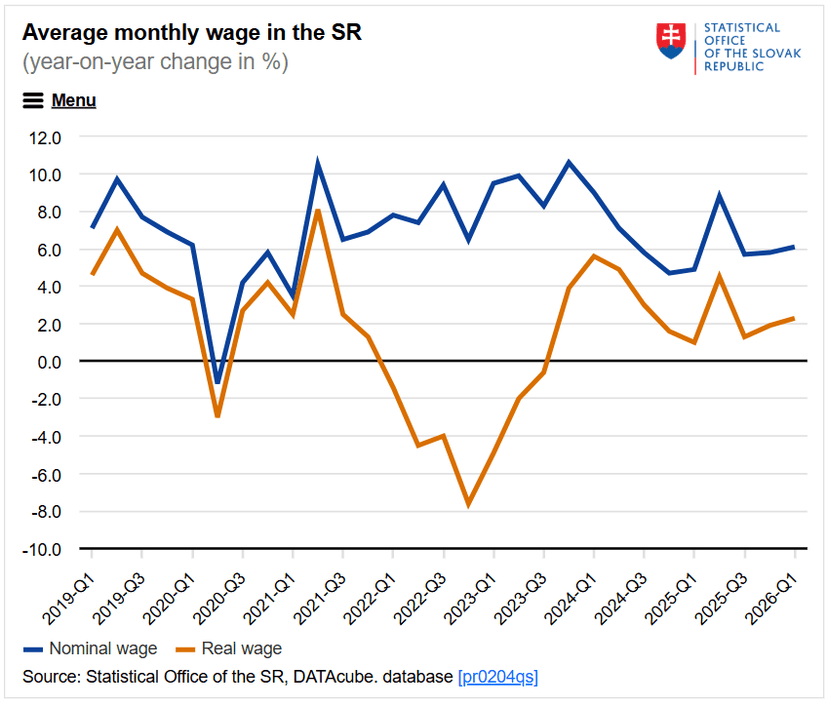
The figure describes the entire economy of the country: factories, shops, hospitals, government institutions — including bonuses and extra payments. It is an average across 19 sectors, not a typical employer offer. Unemployment in the same quarter was 5.9%, 0.6 percentage points higher than a year earlier.
The word priemerná mzda (average salary) in Slovak documents always means the amount before deductions. It is not what goes into the bank account. We keep the breakdown by positions and regions separately — in the section salaries by professions and regions.
Why “average” is misleading and what median shows?
The average inflates the picture. It is pulled up by a few percent of very high salaries, while most workers remain at the bottom.
A fairer guide is the median: the amount above and below which exactly half of the workers earn. For 2024, the median was €1,434 — compared to an average of €1,748 in the same salary structure survey. The gap is €314 per month: the median is 18% lower than the average.
The figure €1,524, also called the average for 2024, cannot be placed next to the median: it comes from quarterly company reports, while the median is from the salary structure survey. The salary structure survey counts only those who actually received a salary in the month: without dohody (agreements outside employment), without sick leave and maternity leave. That is why it gives a higher average.
About every fifth worker reaches the average salary — the rest earn less.
The median moves more slowly than the average because it does not react to the top salaries. But it more accurately describes what an ordinary worker will see in their contract.
What this means for your contract. An offer of €1,300 gross makes no sense to compare with the official €1,611: the difference of €311 looks like a sentence. Compare with the median: against €1,434 for 2024, such an offer falls short by €134. Medián mzdy (median salary) is what makes sense to check your contract against.
A noticeable gap remains between genders. In the third quarter of 2025, average salaries of men were €371 higher than women’s, and by medians the gap was 15.9%.
How much do they pay in different regions of Slovakia?
Of the eight regions, only one exceeds the national average — Bratislava region.
Region | Average gross, Q1 2026 | Difference from national average |
|---|---|---|
Bratislava | €1,984 | +€373 |
Trenčín | €1,499 | −€112 |
Prešov | €1,306 | −€305 |
The other five regions | between €1,306 and €1,499 | below average |
The gap between the capital region and Prešov region is €678 per month, or €8,136 per year. For the same work.
Prešov region is catching up fastest: +10.8% per year versus 6.1% nationally.
One quarter could be a coincidence. The picture for all of 2025 is the same: Bratislava region €1,949, Trenčín €1,522, Prešov €1,285. The fastest growth that year was in Nitra region — 9.1% nominal and 4.9% real.
The order of regions changes between quarters. In Q2 2025, Košice region with €1,629 overtook Trenčín — bonuses in some sectors shift the picture. Comparing regions makes sense only within the same period. Where exactly to look by regions — in the section cities of Slovakia.
How much do they earn in different sectors?
The gap between the highest and lowest sector is more than threefold.
Sector | Average gross, Q1 2026 | Annual change |
|---|---|---|
Finance and insurance | over €3,000 | — |
Industry | €1,721 | +6.0% |
Education | €1,582 | +14.5% |
Trade | €1,518 | +4.5% |
Hotels and restaurants | €963 | — |
Education grew fastest in the economy: +14.5% per year and +10.4% real, ahead of other sectors.
Hotels and restaurants remain the only sector below €1,000. For many of our readers, this is their first job in the country — and here the difference between “national average” and real pay is most painful.
Growth affected almost all: gross salaries rose in 18 of 19 sectors over the year. But after inflation, only 13 remained positive — in others purchasing power fell despite a higher contract amount.
Sectors not in the quarterly release were published earlier by statisticians. For Q2 2025, construction paid €1,164, health and social care €1,962, information technology €2,664, public administration €2,383. This is a different quarter, so these amounts are not in the table above.
Employer size matters as much as sector. In companies with over 1,000 employees, the average salary for 2025 was €2,269 — 7% more than a year earlier. The same profession in a large factory and a small firm is paid differently.
Warehousing and logistics — sectors where many Ukrainians work — are not separately listed in available releases. Monthly reports for April 2026 give only growth percentages without euros. We do not invent numbers. Real rates are visible in employer ads among job vacancies in Slovakia, where usually extra payments for night shifts, weekends, and holidays are specified — in warehouse work these often matter more than the base rate. Who comes here to work and how this changes the market — in our analysis about labor migrants.
How much of this amount do you get in hand?
Less than what is written in the contract. From gross, social and health insurance contributions are deducted, then income tax — only the remainder goes to the account.
In Slovak papers these two amounts are called hrubá mzda (accrued, gross) and čistá mzda (in hand, net). You will see both in your pay slip that the employer issues monthly. Contribution rates and calculation rules are explained separately — there are too many exceptions to fit in one paragraph: gross and net.

Because of this confusion, “average salary €1,200” circulates on the internet. From €1,611 gross about €1,210 comes to the card — here is that same figure, just without the “in hand” label.
If you recalculate the average per hour, with a standard monthly working time fund it is about €9–10 gross. The exact number depends on the number of working days in the specific month.
Slovak job ads almost always show the gross amount. Because of this, two offers are easy to compare with each other, but harder with what you will actually receive. When the employer names an “in hand” amount at the interview, ask if it is gross or net: the difference between the two answers for the same vacancy can be several hundred euros.
Part of the money paid can be returned through annual tax recalculation — how it works we showed in the article about return of overpaid tax.
How have salaries grown in recent years?
Over seven years, the average salary in Slovakia rose from €1,013 in 2018 to €1,620 for the whole of 2025. Intermediate points: €1,133 in 2020, €1,304 in 2022, €1,430 in 2023, €1,524 in 2024.
Nominally this looks good. Really — worse: the 2025 increase after inflation was 2.2% versus 3.7% a year earlier. Growth is slowing.
Another trap in these series is quarterly fluctuations. In Q4 2025 the average reached €1,739, and in Q1 2026 — €1,611. Salaries did not fall: annual bonuses are paid in Q4, so it regularly comes out higher than Q1. You should compare quarter with the same quarter of the previous year.
How does the average salary relate to the minimum?
The minimum salary in Slovakia in 2026 is €915 gross per month, about 57% of the average. The gap is slowly narrowing: in 2023 the minimum was about half the average, €700 versus €1,430, now it is almost three fifths.
How much of these €915 reaches the card and why for one person it remains €915, but the law requires more for another — a separate topic, which we covered in the article about minimum salary. A short definition and hourly rates are in the dictionary: minimum salary.
Why are there such different figures in different sources?
Because sources silently mix four different things. In live search results for average salary today you see €1,200, €1,430, €1,611, €1,650 and even €2,077 — and each number is presented as current.
First — outdated period. €1,430 is the 2023 figure, still on pages without any date. €1,524 is 2024. They look as confident as fresh ones.
Second — gross versus net. Sites with the figure €1,200 often calculate the average from their own job ads and do not mark if it is gross or net. You cannot compare such a number with official €1,611 gross.
Third — monthly peak versus quarterly average. The figure €2,077 is the record for November 2025 from monthly data. Monthly data jump because of bonuses, so quarterly data are smoother.
Fourth reason is subtler: some sites give a forecast, not a fact. The estimate “€1,658 for 2025” circulated for a whole year — the real result was €1,620. The word “orientačne” or “odhad” in Slovak source means forecast.
How to check a source in ten seconds: look for two things — the period name (“Q1 2026”) and the word “gross”. If they are missing — the number says nothing.
The quarterly release is called “Priemerná mesačná mzda v hospodárstve” and comes out about two months after the quarter ends. Data for Q2 2026 will appear in early September — only with them does it make sense to check any amount you see in autumn. Until then, the official figure remains one: €1,611 for Q1 2026.