

The minimum wage in Slovakia from January 1, 2026 — 915 € per month and 5.259 € per each worked hour. The net amount received on the card is 728.90 €: contributions take 131.76 €, tax — another 54.34 €. For more complex work, the law requires more — up to 1,495 € per month.
These 915 € are the minimum for the simplest job. Slovak law divides positions into six stupňov náročnosti práce (levels of job complexity), and the more complex and responsible the work, the higher the legal minimum.
Currently, at least four different figures are circulating: 884 €, 816 €, 800 €, and even 435 €. Only one is correct, and it is printed in the official collection of laws — this is the oznámenie (official announcement) of the Ministry of Labor No. 245/2025 Z. z. dated September 26, 2025. If you want to compare your rate with the market, we have salaries by professions and regions.
What is the minimum wage in Slovakia in 2026?
The minimum wage in Slovakia in 2026 is 915 € gross per month and 5.259 € per hour for a 40-hour week. The amount is valid from January 1 to December 31, 2026. This is 99 € more than last year's 816 €, and as reported by the Ministry of Labor, it is historically the largest one-time increase. In the contract and on the payslip, you will see the Slovak term minimálna mzda.
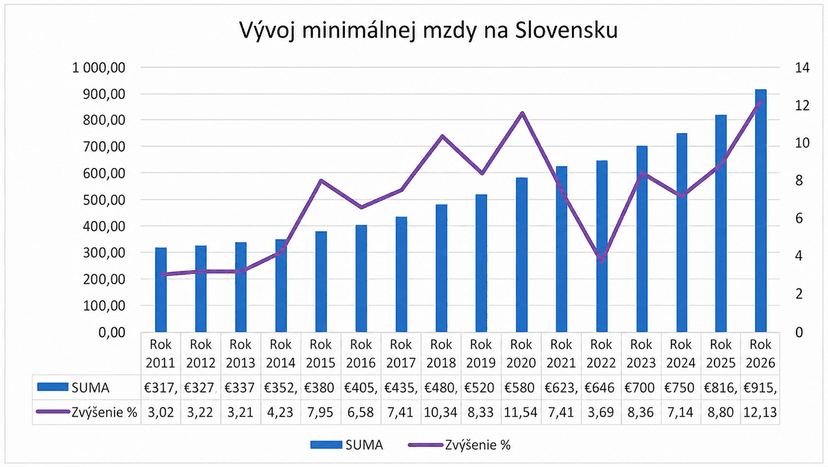
(source: Mzdové centrum)
The amount has not been set manually for a long time. It is calculated automatically: 60% of the average wage for the year before last. The average wage in Slovakia for 2024 was 1,524 €, 60% of which is 914.4 €, rounded up to the nearest whole euro gives 915 €.
The hourly rate of 5.259 € applies to a 40-hour week. A shorter week means a proportionally higher rate: 5.429 € for 38.75 hours and 5.610 € for 37.5 hours. This is required by the minimum wage law and is not an additional favor from the employer.
The minimum wage is the same throughout the country. In Bratislava, it is not higher than in Prešov or Košice, although rent differs almost twice. According to the Ministry of Labor, about 180,000 people work for the minimum wage in Slovakia.
How much of the minimum wage actually comes to the card?
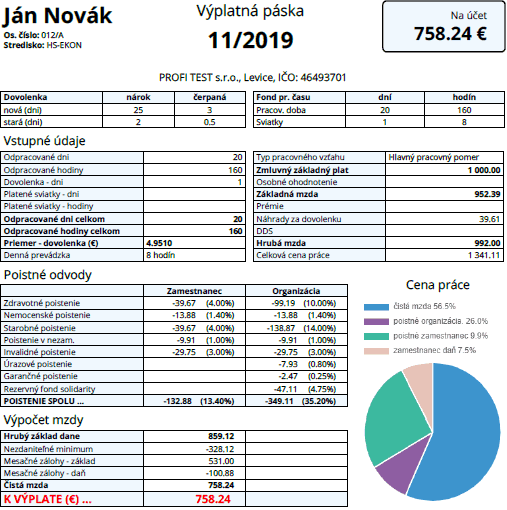
The net amount from the minimum wage in 2026 is 728.90 €. From the gross 915 €, the employee pays 131.76 € in mandatory contributions and 54.34 € income tax. The rest is yours.
Calculation line | Rate | Amount |
|---|---|---|
Gross salary | — | 915.00 € |
Health insurance | 5 % | −45.75 € |
Social insurance | 9.4 % | −86.01 € |
Tax base | — | 783.24 € |
Non-taxable part | — | −497.23 € |
Taxable amount | — | 286.01 € |
Income tax | 19 % | −54.34 € |
To the card | — | 728.90 € |
The main change this year is not in the minimum wage itself. From January 1, 2026, the employee's contribution to health insurance increased from 4% to 5% — this is part of public finance consolidation, and the increase by one percentage point is temporary, until the end of 2027. Because of this, the total mandatory contributions of the employee amount to 14.4% instead of last year's 13.4%. That is why the net minimum wage tables prepared in autumn 2025 show a higher number.
The social part has not changed: according to the tables of Sociálna poisťovňa (Social Insurance Agency), the employee pays 1.4% for sickness insurance, 4% for pension, 3% for disability, and 1% for unemployment insurance — a total of 9.4%.
The line “non-taxable part” is 497.23 € per month, or 5,966.73 € per year, which is 21 times the living minimum of 284.13 € — the amount as of January 1, 2026. From July 1, 2026, the living minimum will be 295.22 €, but the non-taxable part will be recalculated only from January 1, 2027: it is tied to the amount at the beginning of the year, not the current one. It also does not apply automatically. You need to sign with your employer a vyhlásenie na uplatnenie nezdaniteľnej časti (declaration to apply the non-taxable part). Without the declaration, tax is taken from the entire base, and the net amount on the card is 634.42 €. This is 94.48 € less per month. This often happens with a second job: the declaration is signed only with one employer, and the overpayment is then refunded through the annual tax reconciliation.
From the other side of the table: your 915 € cost the employer 1,246.21 € per month — their own contributions add 331.21 € on top. This figure is useful during interviews when you hear “we can’t afford more.”
728.90 € is for an employee without children or disability. Children give a daňový bonus (tax bonus), which reduces the tax itself, and parents receive more on their card.
Why can your legal minimum be higher than 915 €?
915 € is the minimum only for the first of six levels of job complexity. Each next level adds 116 €, and at the sixth level, the legal lower limit is already 1,495 € per month. These minimálne mzdové nároky (minimum wage requirements by level) for 2026 were set by the announcement of the Ministry of Labor No. 244/2025 Z. z.
Level of complexity | Per month | Per hour (40 hrs/week) |
|---|---|---|
1 | 915 € | 5.259 € |
2 | 1,031 € | 5.925 € |
3 | 1,147 € | 6.592 € |
4 | 1,263 € | 7.259 € |
5 | 1,379 € | 7.925 € |
6 | 1,495 € | 8.592 € |
The level is derived from the characteristics of the workplace itself, not from the job title in the announcement. The employer is obliged to assign it to each workplace: they take the most complex work activity at that place and compare it with the descriptions from Annex No. 1 to the Zákonník práce (Labor Code). You can simply ask the HR department about the level of your workplace. They must provide an answer — the obligation to assign lies with the employer, not you.
One caveat. Minimum wage requirements by level apply when payment conditions are not agreed upon in a collective agreement. If there is a collective agreement, check it first.
Supplements for night or weekend work are not included in this minimum. The employer cannot say “with night hours you get 1,100 €, so the level is covered”: first, the base rate must reach the amount of its level, and only then are supplements added on top.
Compare the amount specifically with the official table. Even Slovak calculator websites make mistakes: there are tables where the second level shows 1,036 € instead of the official 1,031 €. If the level is deliberately lowered and talking to HR does not help — check job vacancies in Slovakia with a proper rate.
How much extra is paid for night, weekends, and holidays?
Salary supplements are calculated as percentages of the minimum hourly rate, so from January 1, 2026, they increased along with it — by about 12%. The minimum amounts per each worked hour are:
Saturday — 50% of the minimum hourly rate, i.e., 2.6295 €;
Sunday — 100%, i.e., 5.259 €;
Night work from 10:00 PM to 6:00 AM — 40%, i.e., 2.1036 €, and for risky work 50%, i.e., 2.6295 €;
Difficult working conditions (sťažený výkon práce) — 20%, i.e., 1.0518 €.
Holidays and overtime are calculated differently — based on your own average earnings. For an hour on a public holiday, at least 100% extra is due, for overtime hour — 25%, for risky jobs — 35%.
These percentages can legally be reduced, and HR usually does not tell about this. The common condition: the nature of work or production regime must require regular work on Saturday or Sunday. Then the supplement is lowered to 45% for Saturday (2.36655 €) and 90% for Sunday (4.7331 €). For an employer with a union, this is written in the collective agreement; for an employer without a union who had fewer than 20 employees as of December 31 last year — directly in the employment contract. Below these thresholds is a violation, no matter what is written in the contract.

What to do if you are paid less than the minimum?
First, calculate your legal amount, and only then go to resolve the issue.
Take your payslip for the last month and find the base salary component. Compare it with the amount of your level from the table above — not automatically with 915 €.
Write a written demand to your employer to pay the difference, with date and deadline. Send it by registered mail: oral conversation in court counts for nothing.
Submit a podnet — a request for inspection — to the labor inspectorate: via the slovensko.sk portal, by email, or in writing to the regional inspectorate. The inspection must be conducted within 30 days, in complex cases — within 90. You can submit anonymously, but you will not be informed of the result. In the request, clearly specify the employer's name and address and the place of work — without this, the inspectorate will not determine which regional office is competent.
Be prepared that the money will be recovered by court, not the inspectorate. The inspectorate has no authority to force the employer to pay your salary: it orders to eliminate the violation and imposes a fine. In labor disputes, the employee is exempt from court fees, and often a motion for payment order is enough instead of a full lawsuit. You can also file a criminal complaint for non-payment of salary.
If the salary is not paid within 15 days after the payment deadline, § 69 of the Labor Code gives the right to immediately terminate the employment contract — with compensation equal to two months' average monthly earnings.
Fines for the employer are not symbolic. For violations of labor regulations, the inspectorate can impose up to 100,000 €, for illegal employment — from 4,000 to 200,000 €, and if two or more people work illegally simultaneously, the lower limit rises to 8,000 €. Both lower limits were raised by an amendment effective from January 1, 2026: the general was 2,000 €, and for two or more persons — 5,000 €. There is also mitigation: if the employer pays two-thirds of the fine within 15 days after the decision becomes final, the fine is considered fully paid.
There is also the other side, which is rarely warned about. For illegal work — that is, work without any formal contract — the employee is also fined, up to 331 €. Therefore, the agreement “work without papers for now” is costly for both sides.
Do these rules apply to dohody?
For work under dohoda (agreement), the minimum hourly rate is the same — 5.259 €. This applies to both dohoda o pracovnej činnosti (agreement on work activity) and dohoda o vykonaní práce (agreement on work performance).
Levels of complexity do not apply to dohody: § 120 of the Labor Code is written for employment contracts. A person on a dohoda only needs the basic minimum wage, even if the work is complex and responsible. However, supplements for Saturday, Sunday, night, and holiday work belong to them just like to employees under employment contracts.
How has the minimum wage changed and what will it be in 2027?
In six years, the minimum wage in Slovakia rose from 580 € in 2020 to 915 € in 2026 — by 58%. The intermediate steps were: 623 € in 2021, 646 € in 2022, 700 € in 2023, 750 € in 2024, and 816 € in 2025.
The next step has already been calculated. The automatic calculation takes 60% of the average wage for the year before last: the average for 2025 was 1,620 €, so for 2027 it will be 972 € per month. The Ministry of Labor published this amount on March 3, 2026. Trade unions and employers can still negotiate a different figure; if no agreement is reached, the automatic calculation applies. In the same announcement, the ministry estimated 2028 — about 1,014 €, but the exact amount will again be calculated from the actual average wage.
Get your latest payslip and find the line with the base salary component. If it is less than the amount of your level from the table, you have grounds for a written demand this month.