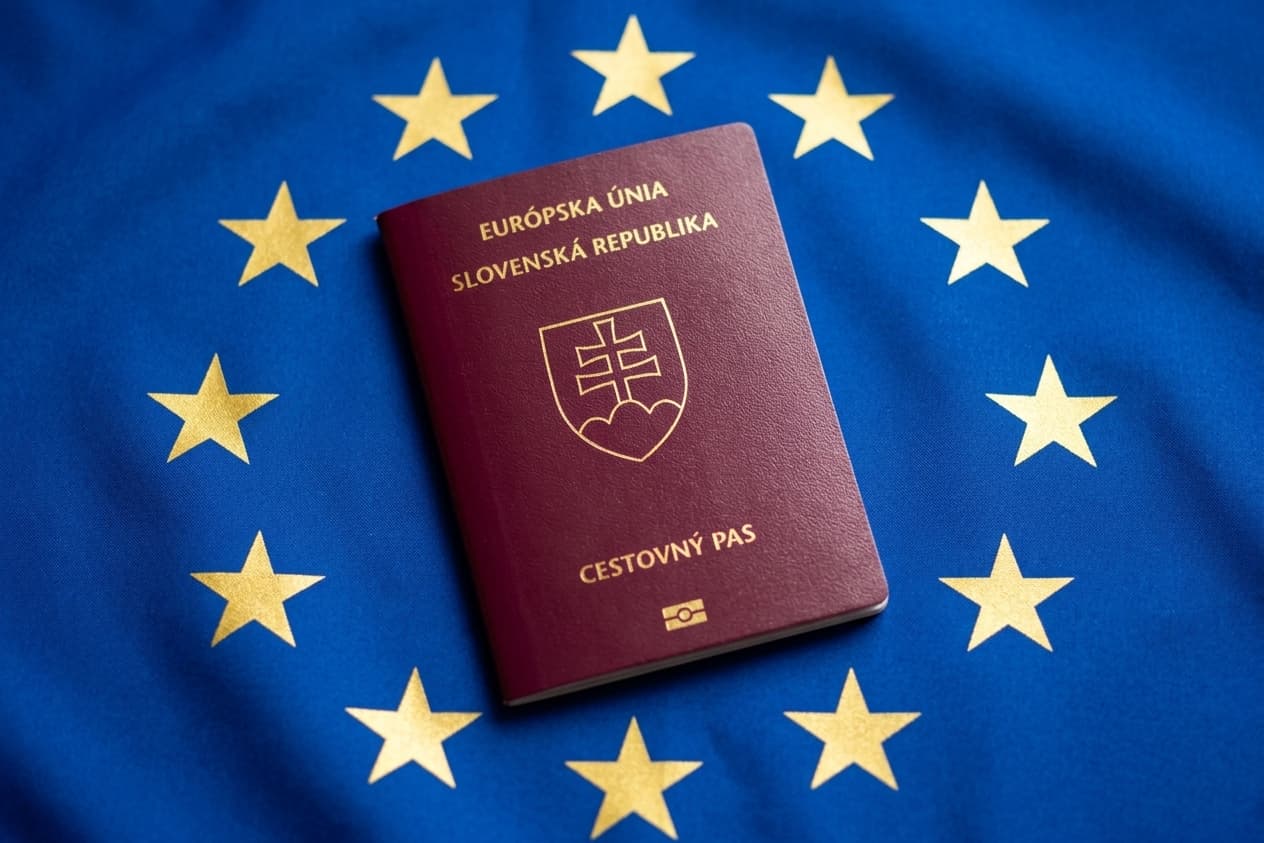

How many years do you need to live in Slovakia to get citizenship?
Eight years. That is the amount of continuous permanent residence — trvalý pobyt (permanent residence permit, PMŽ) — required by § 7 law No. 40/1993 Z. z. directly before submitting the application. Not eight years in the country in general, but eight years specifically with PMŽ status. Years spent on temporary residence permit, studying, or temporary protection do not count in this period — this is why people often miscalculate by several years when they come to the district office.
The second provision of the same paragraph causes even more confusion. The application can also be submitted after ten years of continuous residence in Slovakia — provided that at the time of submission the person already has PMŽ, even if granted just a month ago. Eight and ten do not contradict each other: these are two different doors with their own counters. Agency websites show either one or the other, which causes discrepancies in search results.
The period is not counted by registry entry. The law explicitly requires checking whether the person actually stayed in the territory and how they explain their absence.
Besides the period, § 7 sets nine more conditions. In practice, four of them cause difficulties: good conduct (five years must pass since the expungement of a conviction for an intentional crime), no debts to tax, social, and health insurance authorities, no threat to public order and state security, and passing the Slovak language exam. The other five are procedural: no criminal prosecution, extradition proceedings, deportation case, or asylum revocation case against the person.
Basis | How many years needed | What status is required |
|---|---|---|
General rule | 8 years | Continuous PMŽ |
Long residence | 10 years | PMŽ granted at time of application |
Marriage to a Slovak citizen | 5 years of marriage and cohabitation in the country | Any permitted residence permit |
Birth in Slovakia | 3 years | PMŽ |
Childhood in Slovakia | 3 years PMŽ before age 18 | PMŽ |
Child under guardianship of a Slovak citizen | 2 years (no period required for children under two years old) | Any residence |
Asylum status | 4 years | Asylum |
Foreign Slovak with osvedčenie Slováka žijúceho v zahraničí (certificate of Slovak living abroad) | 3 years | Any residence |
Father, grandfather, or great-grandfather — Czechoslovak citizen born in Slovakia | No period required | — |
Significant contribution to Slovakia in science, sports, economy, or culture | No period required | Permitted residence |
Before counting eight years, you need PMŽ itself — a separate procedure with its own conditions and paperwork: how to get PMŽ.
How many Ukrainians really get Slovak passports?
In 2024, 177 Ukrainian citizens received Slovak citizenship. The year before — 108, in 2022 — 128. In total, in 2024, 879 foreigners became new Slovak citizens, so Ukrainians were about every fifth. Eurostat figures were updated in March 2026; data for 2025 are not yet published.
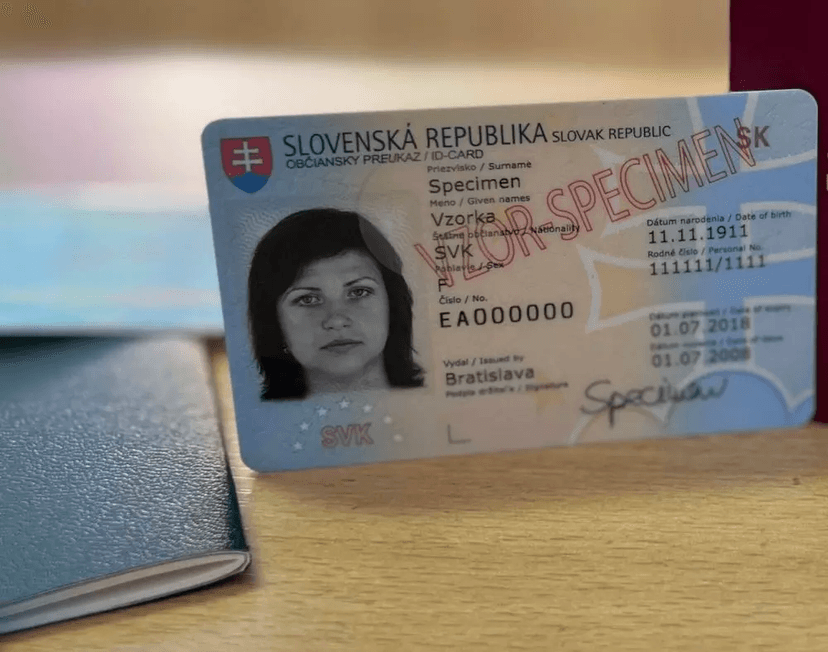
What must be done before applying and how years of temporary protection are counted
Dočasné útočisko (temporary protection) does not directly lead to PMŽ but does not reset the years lived either. While a person remains odídenec (temporary protected person), they cannot apply for dlhodobý pobyt (long-term residence status) — § 52 ods. 2 e) of the foreigners’ residence law excludes odídenec from the five-year rule. First, the status must be changed, and only then the period is counted.
The period itself is counted together with years under temporary protection. The explanation from the director of the Border and Migration Police dated April 8, 2026, instructs to count the time with odídenec status fully in the five-year period: in the lists of § 52 ods. 3 and 4, which name periods that are not counted or counted half, temporary protection is not mentioned. This instruction is methodological and mandatory for police officers — but if it conflicts with the law, the law has priority, and the final word in a disputed case is with the court.
PMŽ in Slovak law has three forms: trvalý pobyt na päť rokov (permanent residence for five years), trvalý pobyt na neobmedzený čas (permanent residence for unlimited time), and dlhodobý pobyt (long-term residence status in the EU). All three count toward the eight-year period.
A realistic path for a person who arrived in 2022 looks like this:
Switch from temporary protection to prechodný pobyt (temporary residence permit) with a specific purpose: work, entrepreneurship, study, family reunification. Without this step, the application for dlhodobý pobyt will not be accepted.
Accumulate five years of legal continuous residence and apply for dlhodobý pobyt. Years lived under temporary protection count toward this period, so for someone who arrived in 2022, the counter has been running for a long time. Study time counts as half, and language skills are tested separately — this is another exam besides the citizenship exam.
Live with PMŽ for eight years and only then apply for citizenship.
Whether years of temporary protection count toward the “ten years of continuous residence” under the preferential rule — the law does not answer directly. The district office evaluates this in each case, so ask there, not on forums. All statuses available to Ukrainians are reviewed in residence options.
How does the Slovak language exam go?
The exam consists of three parts and takes place in one session. First, an interview: questions about the person and their close relatives, then general questions about Slovak history, geography, and socio-political development. Next, the applicant receives a randomly selected article from the Slovak press of at least 500 words — given just before reading, so no prior preparation is possible. The article must be read aloud. The third part is to write a summary of the read article, with 30 minutes given for this.
Language proficiency is checked by a three-person commission appointed by the head of the district office, ambassador, or consul. All three must be present, and the decision is considered adopted if at least two vote for it. On the same day, minutes with each commission member’s evaluation are made; the same newspaper article and the applicant’s manuscript are attached.
Six categories are exempt from the exam:
children under 14 years old at the time of application;
citizens of the Czech Republic — current and former;
holders of a valid osvedčenie Slováka žijúceho v zahraničí (certificate of Slovak living abroad);
people over 65 years old;
those who passed the matura exam in Slovak, the state language exam in Slovak, or the state exam at a Slovak university in Slovak language, if not more than ten years have passed since;
applicants on special grounds — significant contribution to the state, restoration of lost Slovak citizenship, and descendants of Czechoslovak citizens under § 7 ods. 8.
There is no textbook for this exam: no official list of topics exists. The closest format is reading Slovak press aloud and retelling in your own words. Terms from documents are collected in the Slovak terms dictionary, and the language was explained from scratch separately: how to quickly learn Slovak.
Where to submit the application and what documents to collect?
The application is submitted in person — at the district office of the regional center, at the Slovak embassy, or consulate. There are eight regional centers: Bratislava, Trnava, Trenčín, Nitra, Žilina, Banská Bystrica, Prešov, and Košice. You must go to the one corresponding to your PMŽ or last PMŽ in Slovakia. The decision is made not by the district office but by the Ministry of the Interior.
Procedure:
Collect the document package and certify those issued in Ukraine.
Come in person: the official verifies originals against copies and checks identity.
Pass the language exam and fill out the questionnaire — mandatory for everyone from 14 years old.
The district office requests the position of the police and community at the place of residence and sends the case to the ministry.
The application must include a detailed resume, identity document, birth certificate, marital status document, residence document, and certificates of tax, social, and health insurance payments. The most time-consuming item is the certificate of good conduct not older than six months. It must be obtained not only in one country but in every country where the person is or was a citizen and every country where they had permitted residence in the last 15 years. How to get a Ukrainian certificate of good conduct was explained separately.
While the case is in process, every change of data — moving, divorce, name change — must be reported to the ministry immediately. Silence: a fine from 33 to 331 euros.
How much does Slovak citizenship cost?
An adult pays 1,000 euros. The fee is charged only after a positive decision, not when submitting the application, so a failed attempt costs only document, translation, and apostille expenses.
Who applies | Fee |
|---|---|
Person over 18 years old | 1,000 € |
Child under 15 years old | 140 € |
Teenager from 15 to 18 years old | 210 € |
Former Slovak or Czechoslovak citizen | 30 € |
Descendant of a Czechoslovak citizen (father, grandfather, or great-grandfather) | 30 € |
Holder of osvedčenie Slováka žijúceho v zahraničí | 560 € |
Some applicants pay nothing: asylum seekers, displaced persons from Ukraine’s Chernobyl zone, foreigners over 65 years old, disability pensioners, persons with severe disabilities, and those who lost Slovak citizenship after January 1, 1993.
The fee grid shows 210 euros for teenagers, not “210–220” as some agency sites write. Then come citizen documents: občiansky preukaz (internal ID card) costs 7 euros, foreign passport after 16 years old — 50 euros, for children from 6 to 16 years old — 20 euros.
How long to wait for a decision and what is the oath?
The ministry has 24 months — counted from the day the application reaches the ministry itself, not from submission at the district office. The period stops every time the ministry requests the position of another state body and resumes after the response. The initial positions of police and community collected by the district office are not included in this count. Therefore, two years is the lower limit of waiting, not the upper.
The Ministry of the Interior warns separately: there is no legal right to citizenship even if all conditions are met. Accepting a foreigner into the state community is the exclusive right of the state.
Citizenship arises not on the day of the decision. It arises on the day the person accepts the citizenship certificate and before that takes the oath of a citizen of the Slovak Republic. Children under 14 and those whose health condition does not allow are exempt from the oath. Six months are given to collect the certificate after a written summons.
Will I have to renounce Ukrainian citizenship?
No. Slovak law does not require a foreigner to renounce previous citizenship: such a document is simply not in the list of documents for the application (§ 8 ods. 3). The Ukrainian side also stopped taking passports for Slovak citizenship from May 12, 2026.
Article 19 of the Law “On Citizenship of Ukraine” in its current version names voluntary acquisition of citizenship of an aggressor or occupying state — or a state whose citizens cannot acquire Ukrainian citizenship in a simplified way — as grounds for loss.
The Slovak Republic is on the list but was not included immediately. The list was approved by the Cabinet of Ministers by resolution No. 1412 of November 5, 2025, initially including only Canada, Germany, Poland, the USA, and the Czech Republic. Slovakia appeared on May 12, 2026, when resolution No. 589 of May 8, 2026, came into force, and the list grew to 33 states; now there are 34. Article 5-1 of the same law explicitly recognizes multiple citizenship for this case.
One restriction remains. In legal relations with Ukraine, a person with a Slovak passport remains exclusively a citizen of Ukraine. The Slovak document does not exempt from Ukrainian duties and does not give grounds to demand treatment as a foreigner from the Ukrainian state. For specific questions about your case, go to the Ukrainian consulate, not to intermediaries.
A reciprocal rule applies from the other side and concerns Slovak citizens. Anyone with a Slovak passport who voluntarily acquires another citizenship loses Slovak citizenship on the same day. Exceptions exist: citizenship of a spouse acquired during marriage, citizenship by birth or adoption, citizenship acquired by a minor child, and citizenship of a country where the person has lived at least five years. In each case, the district office of the regional center must be notified in writing within 90 days and documents attached. Missing the deadline does not cancel the exception but is an offense with a fine up to 330 euros.
Why are applications denied and when can you apply again?
Most often it is not a denial but a suspension of proceedings. The ministry stops the case if the applicant does not meet either the general eight-year condition or any preferential grounds, or if their residence permit expires during the review. Such a decision cannot be appealed.
After a real denial, a new application can be accepted no earlier than two years from the date the decision became final. A separate rule applies to forged documents: if false significant information is discovered even after issuing the certificate, citizenship does not arise at all.
Calculate your date now: take the month when eight years of PMŽ will be reached and subtract six months — certificates of good conduct are valid for six months, and you must order them in several countries exactly in this window.