
Temporary protection in Slovakia as of August 2, 2026, was held by 149,120 people, and a residence permit of any type — by 221,920 Ukrainian citizens (snapshot as of June 30). Both numbers are official and both are correct. They differ because they count different things — and this is where most texts that repeat them get confused.
How many Ukrainians are in Slovakia now?
The current status of dočasné útočisko (temporary protection), as of August 2, 2026, was held by 149,120 people. The weekly foreign police registry counts everyone to whom Slovakia gave this status: both Ukrainian citizens and those who left Ukraine with a third-country passport.
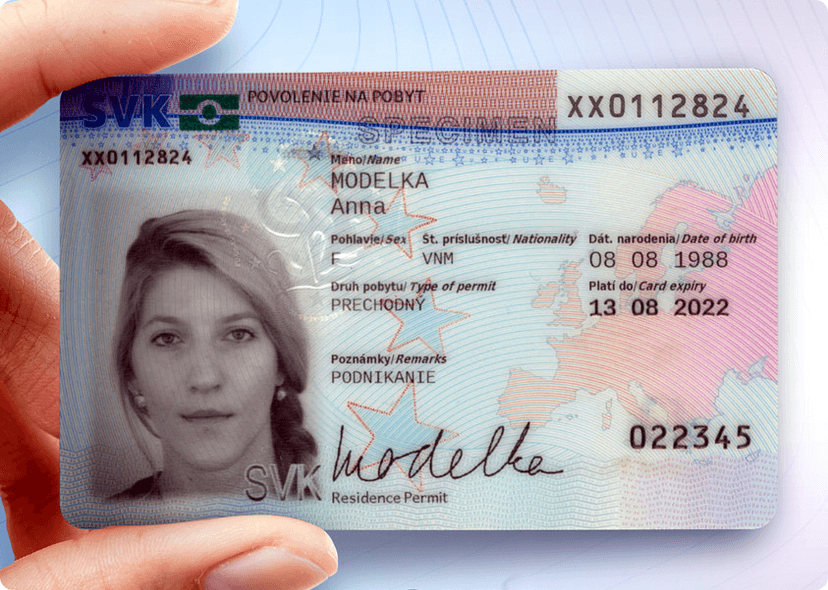
The broader number is 221,920. That many Ukrainian citizens had a valid residence permit in Slovakia as of June 30, 2026. Within this number, there are three different grounds:
tolerated stay, which is the same temporary protection — 146,459;
transitional residence (prechodný pobyt) — 56,299;
permanent residence (trvalý pobyt) — 19,162.
A year ago, at the end of June 2025, there were 201,116 Ukrainians with residence permits. In twelve months, the number increased by 20,804 people. Those aiming specifically for permanent residence will find a step-by-step path in our analysis how to get permanent residence and citizenship.
Why do different sources show numbers from 100,000 to 200,000?
Because each source uses its own metric and almost never states the date of the snapshot. In search results right now, you can find 100,000, 109,000, 118,900, 131,001, 142,000, and 200,000. Almost every one of these numbers was true — for its own date.
Here are four figures that are most often confused for each other.
What exactly is counted | How many | As of |
|---|---|---|
Current temporary protection, all citizenships | 149,120 | August 2, 2026 |
Ukrainians with any residence permit | 221,920 | June 30, 2026 |
Ukrainians specifically with temporary protection | 146,459 | June 30, 2026 |
Permits issued, renewed, or extended to Ukrainians | 26,110 | First half of 2026 |
The trickiest is the last row. The police note in a comment: a permit is considered issued if it was issued, renewed, or extended during the reporting period (January 1 to June 30). Those who simply extended their status are also included in these 26,110. This is why headlines like “26 thousand new arrivals in half a year” appear.
Another number lives separately — 269,111. That many people crossed the Slovak-Ukrainian border in the first month of the full-scale war, the Ministry of Interior reported on March 25, 2022. The same report has a second number: 52,042 people requested temporary protection from March 1, 2022. The first number counts arrivals, the second — those who stayed.
What none of these figures measure is how many Ukrainians physically stay in the country today. The registry sees status, not the person. Those who left and did not deregister remain in the table. The differences between residence grounds are explained in a separate article about residence options.
In which regions do most Ukrainians live?
Half of all those with temporary protection are concentrated in two of eight regions — Bratislava and Košice. The data is the same weekly data as of August 2, 2026.
Region | People with temporary protection | Share |
|---|---|---|
Bratislava | 47,054 | 31.6% |
Košice | 29,392 | 19.7% |
Trnava | 15,049 | 10.1% |
Nitra | 14,671 | 9.8% |
Žilina | 13,444 | 9.0% |
Prešov | 11,701 | 7.8% |
Trenčín | 9,797 | 6.6% |
Banská Bystrica | 8,012 | 5.4% |
In the Bratislava III district, there are 29,330 people — almost twice as many as in the entire Trnava region. Near the Ukrainian border in Michalovce — 15,884. Then with a big gap come Nitra (8,104), Košice I (5,686), and Dunajská Streda (5,500).
This breakdown should not be read as a settlement map. The original column is called “Pobyt v SR — územný celok okres,” meaning this is the address from the police registry. Those who moved within the country and did not change their address remain in the old district. Profiles of individual cities are collected in the Slovak cities catalog.
What share of Slovakia’s population are Ukrainians?
Slovakia’s population as of January 1, 2026, was 5,409,407 people. The country has been shrinking every year since 2022: at the beginning of 2023, there were 5,428,792 people; at the beginning of 2025 — 5,419,451.
149,120 holders of temporary protection make up 2.76% of the country’s population. Ukrainians with valid residence permits, all 221,920, make up 4.1%.
Among foreigners themselves, the share is more noticeable. As of June 30, 2026, there were 376,832 foreigners with valid residence in Slovakia, of whom 221,920 were Ukrainian citizens. Almost six out of ten foreigners here are Ukrainians. The second largest group among third-country nationals are Serbs, numbering 14,564.
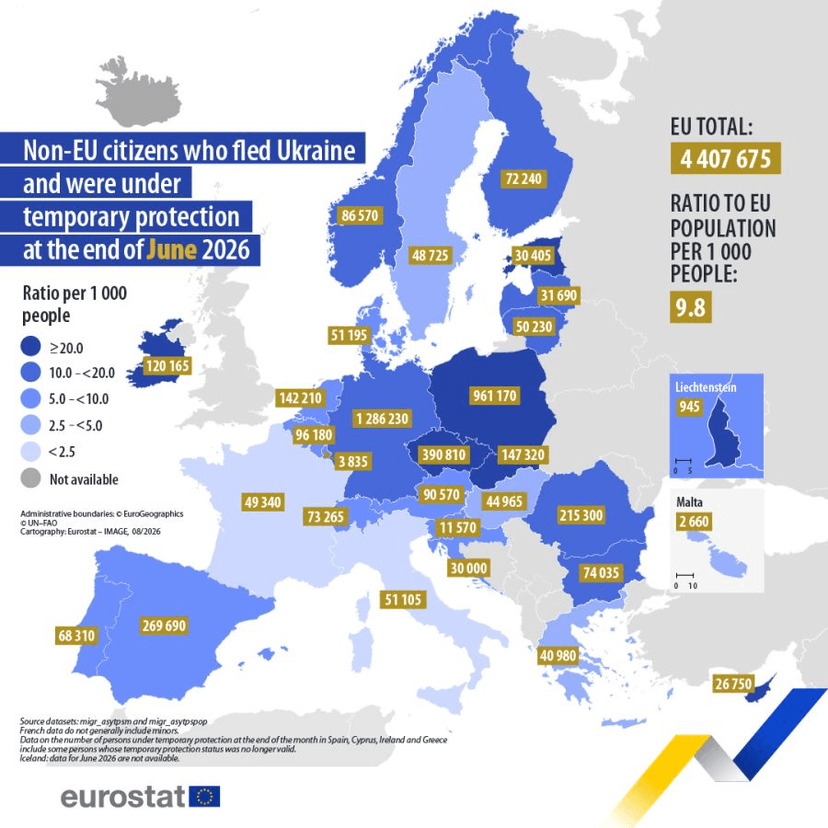
By the number of people with temporary protection per capita, Slovakia is first in the European Union. Eurostat data at the end of May 2026 show 26.8 persons per 1,000 inhabitants — more than Poland (26.5) and Cyprus (25.9). The EU average is 9.7.
How many children, women, and elderly are among them?
In the same weekly registry as of August 2, 2026, there were 41,434 children and teenagers under 18 years old. People aged 18 to 60 were 96,464, and those over 60 were 11,222.
There were 88,527 women and 60,593 men, which is 59.4% versus 40.6%. Children and people over 60 together make 52,656 people — a little more than a third of all those with status.
Eurostat counts the same people by its own age groups and as of June 30, 2026, gives a similar picture. Under 18 — 41,355; 18 to 34 — 43,135; 35 to 64 — 55,850; 65 and older — 6,980.
How many Ukrainians work officially?
At the end of June 2026, 54,570 Ukrainian citizens officially worked in Slovakia. This is the sum of two categories that ÚPSVaR (Labor, Social Affairs and Family Office) counts separately: 11,911 people with a work permit and 42,659 with an information card — this is how holders of temporary protection are officially employed.
In the two categories, women and men switch places. Among information card holders, there are 25,081 women versus 17,536 men, and among those working with a permit, there are 7,091 men versus 4,820 women.
The 54,570 does not include živnosť (sole-trader licence — self-employment). Those working on živnosť are not included in employment statistics: self-employed are counted separately. The real number of working Ukrainians is higher, but how much is not visible from open data.
Who else comes to work in Slovakia and what this changes in the labor market is analyzed in the article about labor migrants. Fresh job vacancies and salaries by profession are collected in our catalogs.

How many Ukrainian children attend Slovak schools?
In the 2025/26 school year, 16,898 children and pupils from Ukraine who arrived after February 24, 2022, studied in Slovak kindergartens and schools. This data comes from the ministry of education’s information system as of September 15, 2025.
The number grows every year: 10,757 in 2022/23, 13,124 in 2023/24, 15,117 in 2024/25, and 16,898 in 2025/26. Before the invasion, on September 15, 2021, there were 3,089 children with Ukrainian citizenship in Slovak schools.
Children grow older, and with them the distribution by type of institution shifts: kindergartens account for 11.7%, basic schools — 63.6%, secondary schools — 24.7%. In 2022/23, secondary schools accounted for 12.1% — their share doubled in three years.
From September 1, 2025, children with odídenec (person under temporary protection) status must attend kindergarten or school if their age falls under compulsory pre-primary education or compulsory school attendance (§ 161r of law č. 245/2008 Z. z.). Before that, there was no compulsory school attendance for foreign children in Slovakia: the ministry explains this clearly in its analysis.
You cannot directly compare 16,898 with 41,434 minors with status: different registries, different dates, and some children have not yet reached school age or study remotely in a Ukrainian school. What parents of first graders should do is explained step-by-step.
Are the numbers increasing or decreasing?
Increasing. According to Eurostat, the number of holders of temporary protection in Slovakia grew every half year without exception. At the end of June 2022, there were 80,470; at the end of that year — 95,550; at the end of 2023 — 114,225. Then 131,525 at the end of 2024, 139,580 at the end of 2025, and 147,320 as of June 30, 2026.
In January 2026, Slovakia made 1,330 new decisions to grant temporary protection, in March — 1,885, in June — 2,555. The current flow is accelerating.
The headline “the number of new refugees fell tenfold” is based on comparison with the peak in 2022, when tens of thousands of people received status in just a few months. It has nothing to do with 2026: within this year, the trend is reversed.
The foreign police registry is updated weekly, so 149,120 will last a few days. The next snapshot will appear on the same police page — in the “Stav k dátumu” row.