
Last summer, the Bratislava-Košice train passed green fields, sunflower plantations, and dense forests. This August, outside the same railway window — yellow-brown grass, dried trees, and rivers shrinking before your eyes.
This is confirmed by measurements. According to the Slovak Hydrometeorological Institute (SHMÚ), as of mid-August 2026, extreme drought covered about 75% of the country's territory. SHMÚ calls the situation the worst at least since 2015.
What the satellites showed
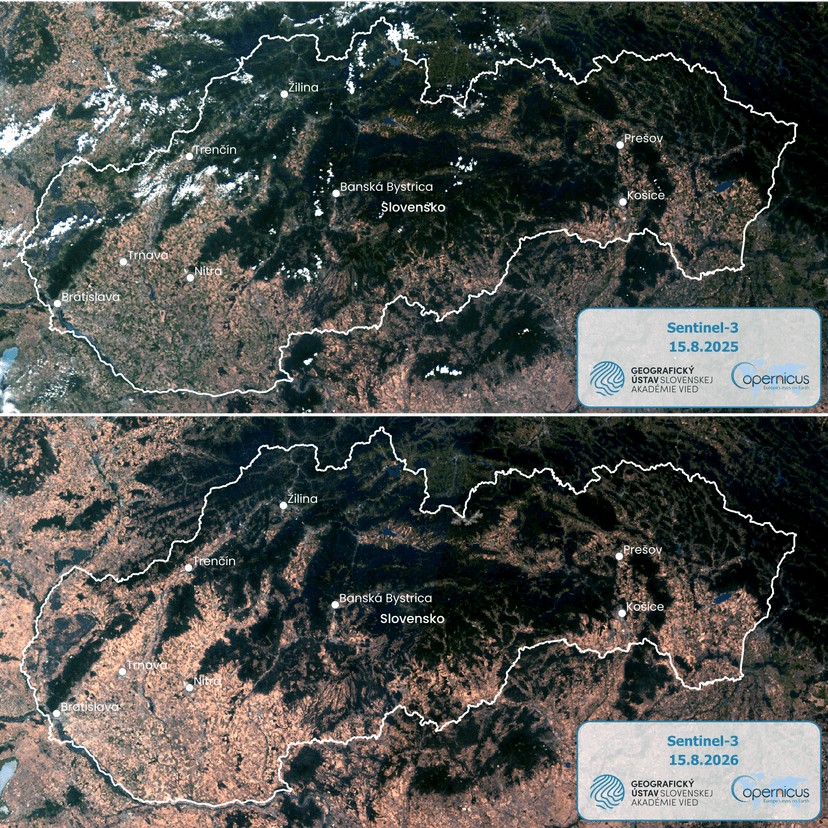
The Geographic Institute of the Slovak Academy of Sciences compared satellite images from Sentinel-3 for August 15, 2025, and August 15, 2026. Both frames were processed with the same radiometric parameters and color settings, so the difference in greenery is real, not a result of processing.
In the 2026 satellite images, you can see how brown and light spots are pushing out last year's green. This is most visible in lowlands and intensively farmed fields.
Impressive numbers
In most areas, the soil received 40 to 80 mm less moisture. In the east, in the Zamagurie and Orava regions, the deficit reaches 80 to 120 mm. In the last 90 days, much of Slovakia received 100 mm less precipitation than normal.
According to the SPI index used by SHMÚ, extreme drought covered most of western Slovakia and locally the Spiš, Šariš, Abov, and Zemplín regions.
There are also records for duration:
In Horný Zemplín, the dry period has already reached 180 days or more.
In Podunajská nížina, Záhorie, and Zemplín, it lasts from 140 to 180 days.
Why it happened
The reason is a long precipitation deficit that began at the start of winter 2025–2026. Several heat waves then worsened the situation: in Podunajská nížina, temperatures rose to 37.5 °C.
Slovakia is not alone. According to the European Drought Observatory, drought warnings were also issued in Hungary, Romania, Austria, and the Czech Republic. The scale of the problem, visible even from space, is reported by global media.
What this means for you
Practical consequences will be felt by everyone living in Slovakia:
Fire hazard. Dry grass and brush ignite quickly, so due to high fire danger, local authorities and forest services in several regions impose restrictions on lighting fires — check current announcements before going out. If you see smoke or fire, immediately call line 150 (hasiči) or the emergency number 112; all Slovakia emergency numbers are collected separately.
Food prices. Agricultural lowlands are most affected: grains, vegetables, and fodder crops are at risk. In previous dry years, this led to higher prices in stores in autumn.
Water restrictions. In several villages and small towns in the east, restrictions on watering lawns, washing cars, and filling pools are already in place or may be introduced. Check announcements from your obec (local council).
Hiking in the mountains. If you plan to go outdoors on weekends, check fire hazard warnings on the SHMÚ website: during highest risk periods, some forest trails are closed.
Meteorologists do not promise a quick change: a single rainstorm will not cover the deficit accumulated over half a year. So, brown Slovakia will likely be seen from space for several more weeks.