
Four hundred euros — that’s how much agencies charge from the first page of Google for nostrifikácia (nostrification, recognition of foreign diplomas) of a certificate. The state fee for the same procedure is 7 euros, and most Ukrainian applicants no longer need it at all. You can submit documents to a Slovak university yourself: prihláška (application for admission) costs 15–50 euros, and studying in Slovak at a public university is free.
The problem is not with the prihláška (application). The Ukrainian certificate alone does not work in Slovakia: it must either be supported by an apostila (Apostila) from the ministry or go through recognition. This step is where admission most often fails: a person applies in February, remembers recognition in August, and misses the enrollment deadline.

Is it still possible to enroll for this academic year?
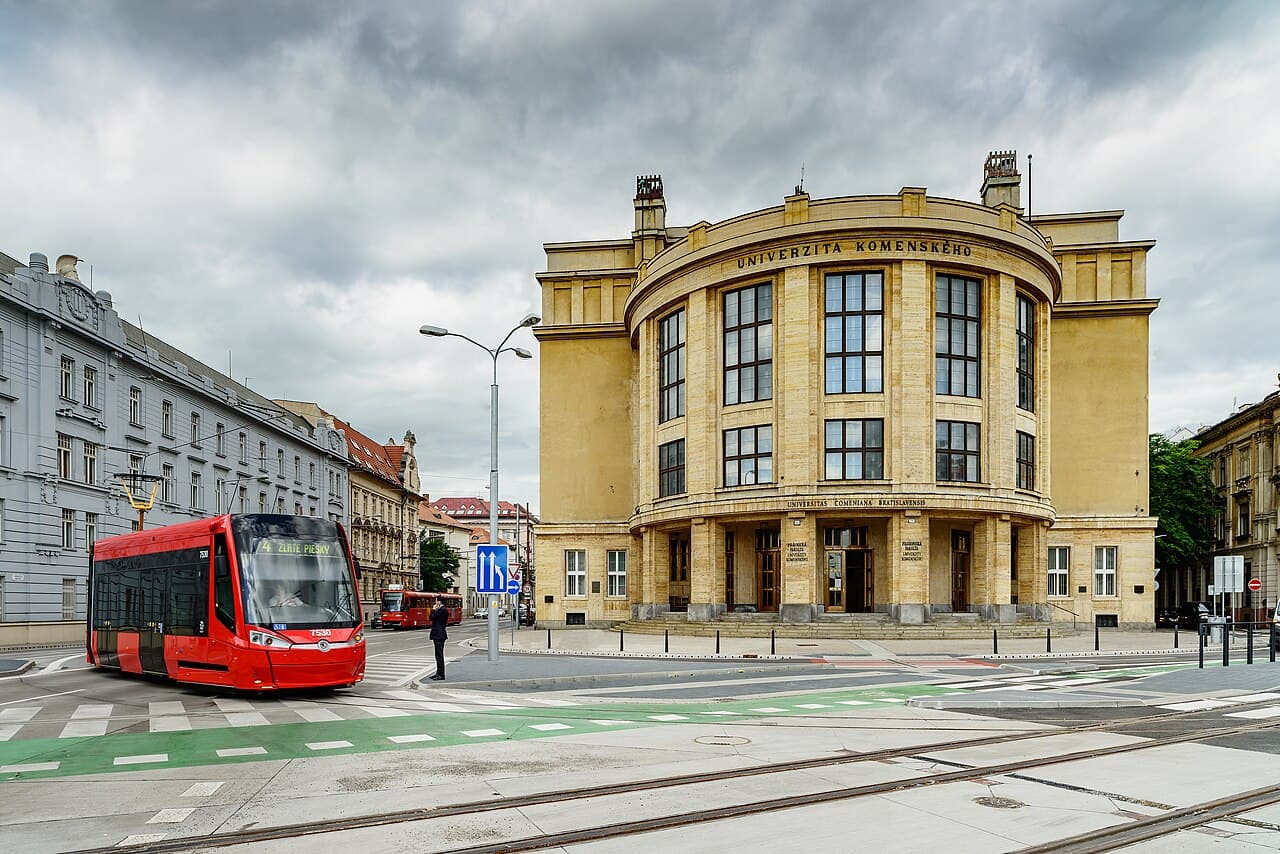
Almost no: most universities closed admissions for 2026/2027 in spring, and the main cycle to aim for is 2027/2028. Last year’s reference: Filozofická fakulta UK opened applications on December 15, and deadlines for other faculties of Univerzita Komenského were between February and April. You won’t miss the exact date: the law requires the university to announce the application period and admission conditions at least two months before the last application day (§ 57 ods. 5 of the Higher Education Act).
An applicant who has not confirmed basic admission conditions at the time of verification can be conditionally admitted by the university, with the obligation to submit documents no later than the enrollment day (§ 58 ods. 1). So you don’t have to wait for the recognition decision before applying; both processes run in parallel.
Where to apply is a separate question. Choose by field and specific program; the university’s name matters least here. We have collected 39 public and private universities with faculties and admission conditions.
Stage | When (2027/2028 cycle) | Cost | Response time |
|---|---|---|---|
Invitation to university | December 2026 — February/April 2027 | 15–50 € per program | 30 days after condition check |
Entrance exam, where applicable | May — June 2027 | included in application fee | — |
Recognition of certificate | anytime before enrollment day | 7 € state fee | up to 1 month |
Enrollment and dormitory application | July — September 2027 | from 300 € per month per bed | depends on university |
Residence permit for study, who needs it | after admission decision | application free, fee only for card | 30 days |
Second rounds and additional admissions in summer happen but rarely and briefly. For 2026/2027, such windows remain at Fakulta matematiky, fyziky a informatiky Univerzity Komenského — applications until August 20, 2026, dormitory until July 20 — and Filozofická fakulta UK, where the second round lasts until August 7, 2026. Check these dates on your faculty’s admission page.
What documents from Ukraine are needed and which are translated by a sworn translator?
The list is short: certificate, transcript with grades, passport, completed application, and proof of fee payment. Half of these do not need translation, although applicants often spend the most unnecessary money on translators.
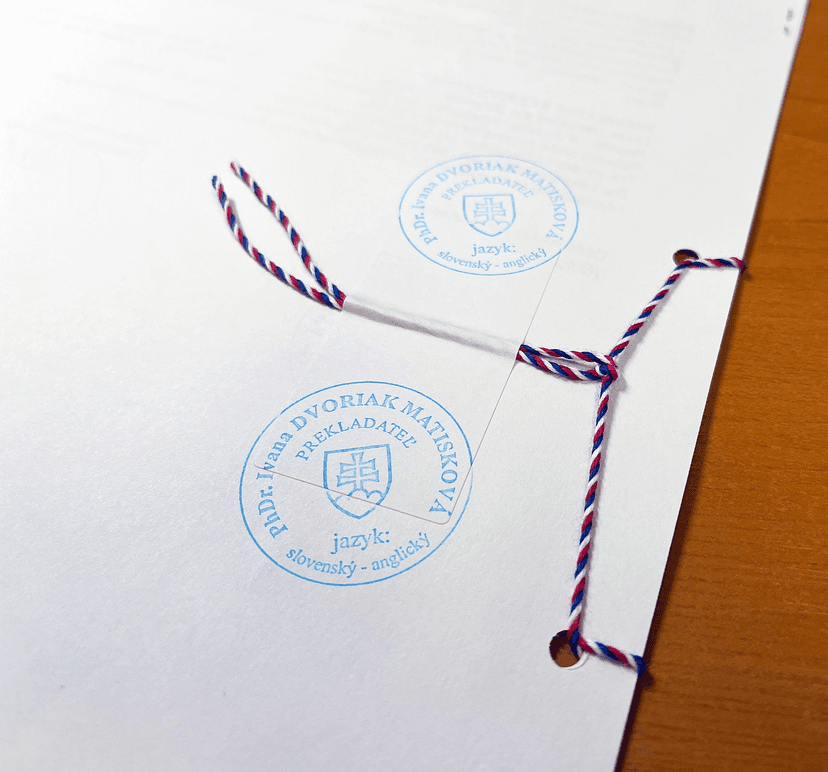
Certificate of complete secondary education. Certified copy plus úradný preklad (official sworn translation) into Slovak. Without it, the recognition application will not be accepted.
Transcript with grades. For recognition under bilateral agreement, it is not required at all: it is listed only for countries without agreements. But the university itself may request the transcript with the application.
Foreign passport. A regular photocopy, no translation needed.
Document granting dočasné útočisko (temporary protection). The ministry lists a regular copy (bežná kópia) in the recognition application attachments, no certification needed.
Proof of fee payment. eKolok — electronic stamp with QR code, bought at the post office or via app.
A diploma issued in Russian does not require sworn translation: for recognition of higher education degrees, the ministry accepts own translations from Russian, English, German, French, and Hungarian, and no translation is needed from Czech or Latin. This privilege does not apply to certificates: there, úradný preklad is required without exceptions.
No apostila (Apostila) is needed. It is not listed among attachments for recognition of Ukrainian certificates because Slovakia has a bilateral agreement with Ukraine on mutual recognition of education documents. A separate university may request legalization for a specific program, so read your faculty’s admission conditions carefully. Find a translator in the Ministry of Justice registry: we explained how it works in the article about where to find a sworn translator.
A special case is a certificate left in Ukraine. For people with odídenec (refugee status), the law allows proving secondary education by an honest declaration and a general skills test; this is § 56 ods. 2 of the Higher Education Act. This norm is usually not found in general admission conditions because each university specifies details in its internal regulations.
Why no longer order nostrifikácia (nostrification) for 400 euros?
Because a free document appeared that replaces it. Uznávacia doložka (recognition clause) under § 39a of Act No. 422/2015 Z. z. replaces the recognition decision for secondary and higher education degrees if you continue studying at a university.
You go to the ministry’s database, select country “Ukrajina,” find your qualification, download the PDF, and print it. It has no stamp or signature and never will: validity is checked by QR code. Certified copies of the clause are prohibited, the ministry itself writes so. Clauses have already been issued for over 200 common qualifications from 27 EU countries and three countries with bilateral agreements with Slovakia: Ukraine, Russia, and China.
The clause has two limits. It confirms only the education degree and does not grant the right to be admitted to the chosen program. And it does not work for regulated professions: doctors, nurses, teachers, pharmacists must still undergo full qualification recognition.
If your document has no clause in the database, only regular nostrifikácia (nostrification) remains. It also does not cost 400 euros.
What is recognized | Who decides | State fee | Decision time |
|---|---|---|---|
Secondary school certificate | Regionálny úrad školskej správy (Regional School Administration Office) in the regional capital | 7 € | up to 1 month |
Diploma, degree only | Ministerstvo školstva, Stredisko na uznávanie dokladov o vzdelaní (Ministry of Education, Center for Recognition of Education Documents) | 7 € by mail, 3.50 € electronically | 1 month |
Diploma with field of study | Slovak university itself | 7 € | up to 2 months |
Part of studies, separate years | university or school director | according to institution rules | up to 2 months |
The recognition application for the certificate is submitted not to the ministry but to the regional school administration office (regionálny úrad školskej správy) at the place of residence or study. A letter sent “to the ministry in Bratislava” will only delay the process. If there is no agreement with the country, the fee is 40 euros and the decision time up to two months. The decision can be appealed within 15 days of delivery. The step-by-step procedure with forms is described in a separate article about simplified recognition of certificates.
How much does admission and studying cost?
The prihláška (application) costs from 15 to 50 euros per program; electronic is about twice cheaper than paper. The law sets a ceiling: the admission fee cannot exceed 25% of the base amount, and the base amount for 2026/2027 is 780 euros. So they cannot charge you more than 195 euros for the application. The university also cannot require any other payment as a condition of admission; this is explicitly prohibited by § 57 ods. 1 of the Higher Education Act. This is the line between official fees and “all-in packages” from intermediaries.
Studying full-time in Slovak at a public university is free. Školné (tuition fee) applies in four cases: part-time studies, programs exclusively in a foreign language, studies longer than the standard duration, and a second parallel program of the same degree.
The second point is often misunderstood. A program becomes paid only if it is entirely in a foreign language. A course combining Slovak and English counts as a state-language program and remains free. The annual tuition ceiling for full-time studies is 3,900 euros, i.e., five base amounts, but this does not apply to programs exclusively in a foreign language: there, the university sets the price itself.
A student with dočasné útočisko (temporary protection) has no tuition fee obligation at all; this is recorded in § 92 ods. 11 of the Higher Education Act, alongside those granted asylum and additional protection. Neither English-language programs nor “extra” study years will cost money.
Are there entrance exams and is a Slovak language certificate needed?
Often there is no entrance exam at all. The basic admission condition for a bachelor’s degree under Slovak law is one: completed full secondary or vocational secondary education (§ 56 ods. 1). Ukrainian external independent testing (ZNO) or national multi-subject testing (NMT) are not part of Slovak admission conditions. For a master’s degree, the condition is different and arithmetic: the sum of credits from previous studies and credits needed to complete the master’s program must be at least 300. A Ukrainian bachelor’s degree is 240 credits, so the master’s program must add at least 60.
In natural sciences and mathematics fields, an exam is scheduled only if applications exceed places; this is done by Prírodovedecká fakulta UK. At FMFI UK, there is no separate entrance exam at all: it is replaced by a percentile of an authorized math test. Medicine, dentistry, arts, and sports fields are the opposite pole, where selection is practically everywhere and strict. Another detail in your favor: additional admission conditions by law cannot go beyond the secondary school program (§ 57 ods. 2).
The language situation is more subtle than “B2 level required.” There is no general certificate requirement: at Filozofická fakulta UK, only applicants to certain programs take a Slovak exam, not all. The requirement exists at the program level, not faculty or university. So the only reliable way is to open your program’s page in the education catalog and read the admission conditions fully, to the last paragraph.
What happens to the odídenec (refugee) status if you enroll?
Nothing — until you apply for a student residence permit. Here lies a trap no agency shows.
Under § 32 ods. 1 písm. c) of Act No. 480/2002 Z. z., temporary protection ends as soon as a person is issued prechodný pobyt (temporary residence) or permanent residence. The odídenec status simply disappears, along with free tuition under § 92 ods. 11 and the right to a social scholarship.
The third loss is freedom to work part-time. A foreigner with a student residence permit can work no more than 80 hours per month total for all employers, according to § 23a of the Employment Services Act (high school students have half, 40 hours). A holder of temporary protection has no such limit. If you plan part-time work during studies, the difference is noticeable.
If you have dočasné útočisko (temporary protection), enroll with it: no separate residence permit for study is needed.
A student residence permit is needed for those coming from Ukraine without status. The application is submitted personally, at a consulate or foreign police department; there is no fee for the application itself, only for the card issuance. Attach a color photo 3 × 3.5 cm, valid foreign passport, admission confirmation, certificate of no criminal record, and proof of financial support: bank statement for three months, scholarship confirmation, or honest declaration of the person supporting you. Certificates must be no older than 90 days. Police decide within 30 days of full application submission. The permit is granted for the expected study duration, maximum six years. Within 30 days after receiving the card, a medical report from an infectious disease specialist must be submitted.
What happens after the diploma, we explained separately: graduates have the right to nine months of residence permit to look for work.
What scholarship can you apply for?
A social scholarship if the family income is below the set limit. And here is a line of law often omitted by universities themselves.
§ 96 ods. 1 of the law, valid until August 31, 2026, names recipients as: students with permanent residence in Slovakia “or students granted asylum, additional protection, or temporary protection.” Dočasné útočisko gives the right to sociálne štipendium (social scholarship) equally with trvalý pobyt (permanent residence), and the law calls this právny nárok — a legal right of the student that the university must recognize. Some university pages print only the first half of the sentence and turn students away at the door. If you were refused with such wording, ask for a written decision citing the norm.
Amounts for 2025/2026: minimum 10 euros per month, maximum 330 euros if the university is within 30 km of residence, and 395 euros if farther. Paid from September to June, by the 10th, to a Slovak bank account. The application is submitted at your university after enrollment.
There will be no new edition of these amounts, and the reason is technical: from September 1, 2026, Regulation No. 102/2006 Z. z. is repealed along with the Higher Education Act itself — both acts named in the repeal provisions of the new Act No. 300/2025 Z. z.. Instead of fixed numbers in the regulation, it ties both income limits and scholarship amounts to the subsistence minimum (§ 111 ods. 5). The right of odídenec does not disappear: § 111 ods. 1 names recipients as students with permanent residence “or students granted international protection, additional protection, or temporary protection,” and repeats that the student has the right to a social scholarship.
The motivational scholarship is assigned by the university itself, and the type of residence does not matter. There are two grounds: studying a specialty with labor market shortage — such scholarship is received by at most half of students in the field; and excellent results — no more than ten percent of university students. First-year students get grades from the last year of secondary school.
A pregnant student receives 200 euros per month, but for this payment the law already requires permanent residence in Slovakia.
Will you get a dormitory and what to do if not?
Chances are about two-thirds, and this is in the hardest city: in Bratislava last admission, 3,282 applications were submitted for 2,169 beds. A bed in a double room costs from 300 euros per month. We collected numbers and schedules for specific dormitories in the article about Bratislava dormitories.
The situation is slowly improving: renovations added 963 beds — Starohájska and Vlčie hrdlo in 2025, Dolnozemská in June 2026. Bellova with its 162 places will open only in May 2027.
This is hardly written anywhere: some faculties set their own early application deadline for those wishing to get a dormitory. At FMFI UK it is July 20 instead of August 20. If you apply a day later — you will be admitted to studies but not considered for a dormitory place. Read admission conditions in the part about housing.
What to start this week?
Open the clause database on the ministry’s website, select country “Ukrajina,” and see if there is a clause for your certificate type. If yes — you just saved 400 euros and a month of waiting. If no — fill out a recognition application at the regional school administration office: 7 euros and up to a month.
The next application window will open around December 2026: last year Filozofická fakulta UK started accepting applications on December 15, and the 2027/2028 cycle will start then. Our other materials about studying are collected in the “Education” section.