

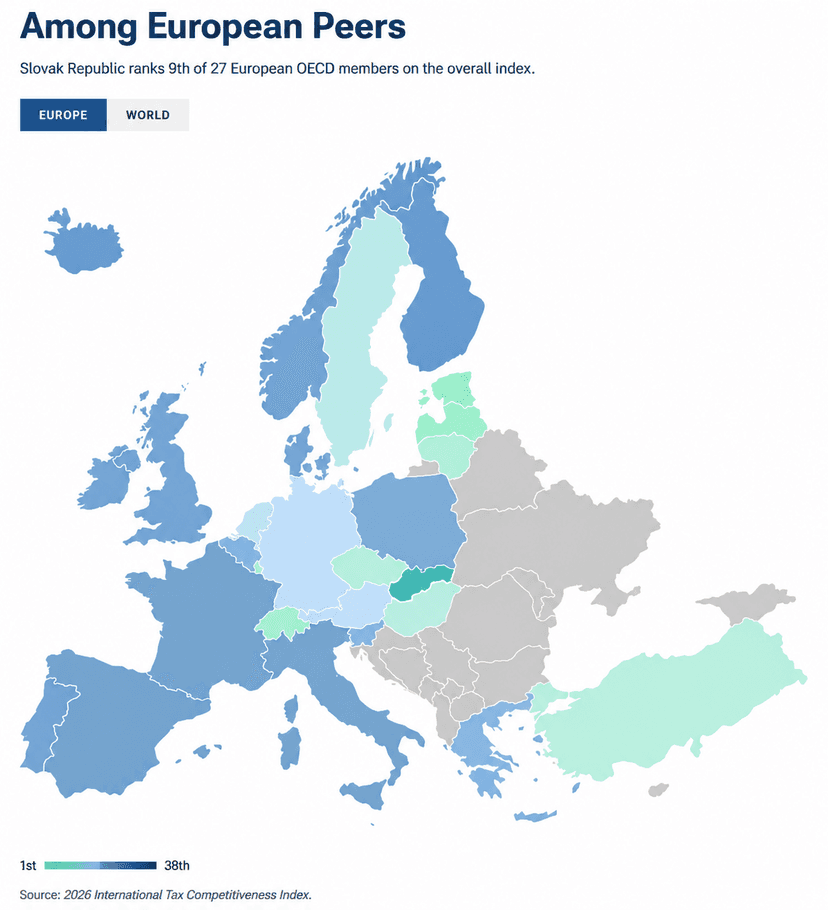
The Slovak Republic has dropped to 12th place in the latest edition of the prestigious International Tax Index 2026, a tax competitiveness ranking compiled by the Tax Foundation think tank. Compared to last year, the country has dropped three spots (it ranked 9th in 2025), but among OECD European countries, it still remains in the top third—ranking 9th out of 27 countries.
The study’s authors analyzed key changes in the country’s fiscal policy, including an increase in the corporate tax rate to 24%, the introduction of a financial transaction tax, and a rise in the top personal income tax rate to 44.4%.
What the Numbers Say: Strengths and Weaknesses of the Slovak Tax System
The ranking evaluates national tax systems across five key categories. Slovakia’s rankings are as follows:
Individual Taxes — 2nd place worldwide (94.6 points). This is one of the country’s strongest advantages. Slovakia maintains extremely favorable conditions for investors and citizens: the dividend tax is only 7% (compared to the OECD average of 24.7%), and capital gains are not taxed at all after a minimum holding period.
Property Taxes — 7th place (74.4 points). The country has no taxes on inheritance, gifts, real estate transfers, or capital increases, and local property taxes can be deducted from corporate income.
Corporate Taxes — 24th place (60.8 points). Despite favorable depreciation rates for investments in equipment and patents, companies face strict limitations on carrying forward losses from previous years to future periods.
Cross-Border Tax Rules — 17th place (72.3 points). The ranking remained unchanged compared to last year.
Consumption Taxes — 33rd place (43.0 points). This is the weakest aspect of the Slovak system due to the high base VAT rate (24%) and a narrow tax base with high registration thresholds.
What caused the drop in the ranking?
Experts note that recent legislative changes have negatively impacted the overall competitiveness index. Specifically, in 2025, the corporate tax rate rose from 21% to 24%, and a controversial financial transaction tax was introduced. In 2026, the trend continued—the maximum income tax rate for individuals rose from 35% to 44.4%.
At the same time, experts view the absence of bureaucratic hurdles in the transfer of real estate or inheritance positively, which makes the country attractive for private investment despite the overall deterioration in fiscal conditions.