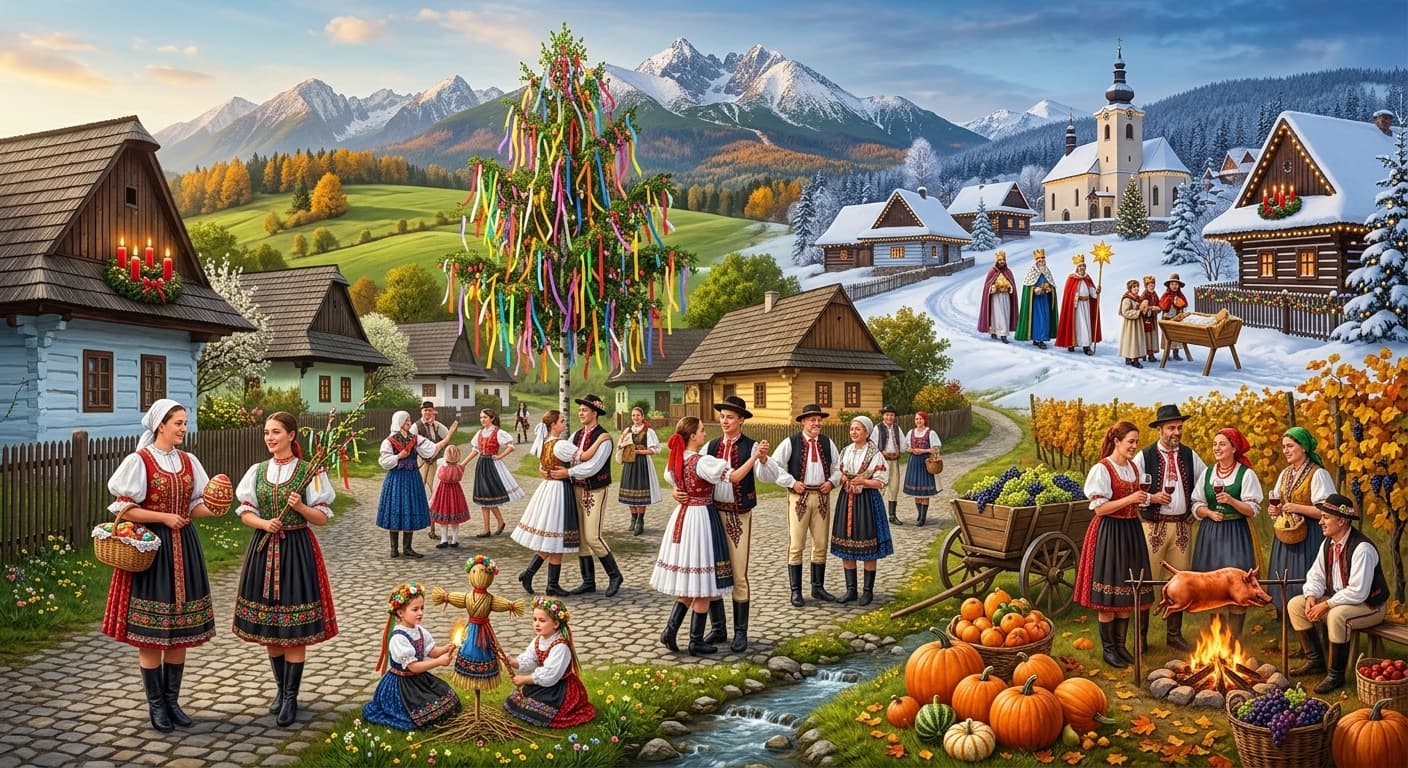

The annual cycle of events in Slovakia is stable: carnival in February, city days in spring, Night of Museums in May, open-air festivals in summer, Christmas markets from the last days of November. But the posters are scattered. Official city websites, ticket platforms, and thematic channels each run their own, and their dates sometimes differ.
What events take place in Slovakia throughout the year?
The backbone of the event year is city holidays and festivals that repeat for decades. Dates vary within a week, the month stays stable. The busiest periods are May, July with August, and the period from the end of November to Christmas. The emptiest are January and February. Then only theaters, cinemas, and carnival weekends remain from the big events.
When | What | Where | Date |
|---|---|---|---|
February | Bratislavské fašiangy, carnival festivities | Bratislava | February 6, 2027 |
April | Bratislavské mestské dni | Bratislava | April 24–25, 2027 |
April–May | City Days of Košice | Košice | around May 7 |
May | Noc múzeí a galérií (Night of Museums and Galleries) | whole country | Saturday in May (2026 — May 23) |
June | Slávnosti rusínsko-ukrajinskej kultúry (Festival of Rusyn-Ukrainian Culture) | Svidník | June (2026 — June 19–20) |
July | Pohoda | Letisko Trenčín (Trenčín Airport) | July 8–10, 2027 |
July–August | Bratislavské kultúrne leto (Bratislava Cultural Summer) | Bratislava | July 1 — August 30, 2026 |
September | Rímske hry (Roman Games) | Bratislava | September 26, 2026 |
October | Medzinárodný maratón mieru (International Peace Marathon) | Košice | first Sunday of October |
November | Festival mladého vína (Young Wine Festival) | Bratislava | November 6–7, 2026 |
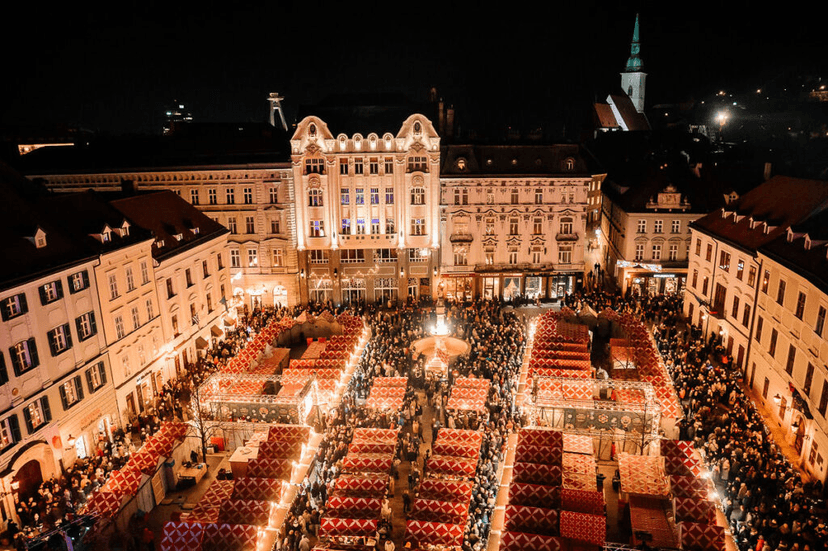
November–January | Bratislavské Vianoce (Bratislava Christmas) | Bratislava | November 27, 2026 — January 3, 2027 |
Summer is arranged differently than winter: instead of one big market, there are a dozen parallel festivals. In Bratislava, this is Bratislavské kultúrne leto (Bratislava Cultural Summer) with stages in districts and Lovestream Festival at the beginning of August; in Košice — Leto v Kulturparku (Summer in Kulturpark) open-air. The biggest music event in the country, Pohoda, gathers people at Letisko Trenčín (Trenčín Airport) in July. The spring half of the year relies on city holidays: City Days of Košice celebrate the privilege King Ľudovít Veľký (Ľudovít the Great) gave the city on May 7, 1369, and Košická hudobná jar (Košice Music Spring) and the MFF Art Film Košice film festival run in May and June.
The strongest season is vianočné trhy (Christmas markets). In Bratislava, they occupy three squares: Františkánske námestie, Hlavné námestie, and Primaciálne námestie. Entrance is free; you pay only for food, mulled wine, and gifts. What exactly happens there and how Slovak Christmas differs from Ukrainian Christmas is explained in the Christmas traditions article.
When you see date discrepancies, trust the page of the event organizer, not the aggregator. Planning a trip to another city? Check the calendar of public holidays: some city programs change on those days, and some venues are closed.
Where to watch event posters in Bratislava, Košice, and other cities?
Every big city has its own official announcement channel, which is more accurate than aggregators: it is filled by those who organize the event. One downside — almost everything is in Slovak. The upside is the same: you see the original names, which you will then use to search for tickets.
Bratislava. On bratislava.sk there is a block "Najbližšie podujatia" (Upcoming events), and the button "Všetky podujatia" (All events) leads to bkis.sk — the site of Bratislavské kultúrne a informačné stredisko (Bratislava Cultural and Information Center), a city cultural-information bureau with an office at Hviezdoslavovo námestie 20. Posters can be filtered by type podujatie (event): discussions, theater, festivals, cinema, concerts, children's programs, exhibitions, workshops. Besides the list, there is a calendar view and a PDF program download, and the label "Dostupné pre imobilných" shows events accessible for visitors with limited mobility. The same Bratislava events in Ukrainian are collected by our Bratislava poster.
Košice. The city website kosice.sk holds a section "Kultúrne podujatia" (Cultural events), and the tourist poster lives separately at visitkosice.org. There is also the most useful page in the whole selection — "Každoročné podujatia" (Annual events), about three dozen yearly events with months. From there you can see that October in Košice is the marathon and Biela noc (White Night), and September is the street food festival and Ivan Sokol organ festival. The main events are duplicated by our Košice poster.
Prešov moved its poster to a separate portal gopresov.sk, run by the city hall: besides Slovak, it has English and German, and organizers can submit events via the "Pridať podujatie" (Add event) form. Žilina holds a "Kalendár podujatí" (Event calendar) on tikzilina.eu, managed by the city tourist information center.
The national level is covered by slovakia.travel with its "Kalendár podujatí" and filters by region and dates. Language versions: Slovak, English, German, Hungarian, Polish, and Chinese. Ukrainian is not among them, so the national calendar must be read in Slovak or via a translator.
A separate scenario is "what's today." City posters show the current day on the first screen, which is faster than scrolling an aggregator: bkis.sk has a calendar view, visitkosice.org — a grid of the current month with clickable dates. If you organize something yourself, both portals accept submissions. In Bratislava, this is the "Pridať podujatie" button; in Prešov — the same form on gopresov.sk. For the Ukrainian audience, events are also collected in our poster section: the card shows the city, date, event language, and price, including the label "Free."
The unofficial layer also works: city Telegram channels, Instagram communities, district chats. Among them is our channel АФІША | Словаччина, where we collect event announcements and venue selections in Ukrainian. What else Ukrainians read in Slovakia is in the selection of channels and chats.
Where to buy tickets and what to check before payment?
There are three big platforms, plus a separate layer for the Ukrainian audience. The price is set by the organizer — the services differ in other ways: whose events are there at all and what language they speak to you in.
Service | What it sells | Interface language | What to consider |
|---|---|---|---|
theater, sports, concerts, festivals | sk, en, de, ru, hu | electronic HomeTicket and MOBILticket | |
concerts, sports, shows, theater, festivals, children | sk, en | opens on predpredaj.zoznam.sk, operator MADWIRE, s.r.o. | |
concerts, theater, cinema, festivals, parties | sk, en, cz | the only big service with full Ukrainian interface | |
tours of Ukrainian performers | uk | almost no coverage of Slovak classics and local festivals |
Predpredaj (pre-sale of tickets) filters events across all eight regions of Slovakia — useful if you live outside Bratislava and Košice. GoOut sells tickets directly and holds separate categories for cinema and theater.
Besides the ticket price, there is a transaction fee, which is not refunded even when the ticket price is returned: Ticketportal's terms state that this fee is non-refundable (clause 3.31). So searching for "tickets without commission" usually ends at the platform's own checkout.
Before payment, check the date and time, exact venue name, ticket delivery method, and who the seller is — the service itself or a third party. Electronic HomeTicket or MOBILticket arrives immediately after payment; paper tickets must be picked up at the box office, which means an extra trip across the city.
The last point concerns resale. Ticketportal does not recommend offering vstupenka (ticket) to third parties: according to the service terms, the buyer from a resale loses client status, and there is no way to verify the code's authenticity before entry (clause 6.4).
Can you return a ticket if the event is canceled?
The usual 14-day right of withdrawal from online purchases does not apply to tickets. The Consumer Protection Act No. 108/2024 Z. z. in § 19 ods. 1 písm. l) excludes leisure services from this right if the contract specifies a precise time or period for the service. A concert with a specific date on the ticket is exactly such a case, so you cannot change your mind "within two weeks."
What this means in practice is seen in Ticketportal's terms:
if you did not attend the event for a reason not dependent on the organizer, there is no right to a refund (clause 3.33);
if there is a valid reason for contract withdrawal, money is refunded within 30 days, but the transaction fee remains with the service (clause 3.31);
the organizer (usporiadateľ) is fully responsible for restrictions, changes, and cancellations, not the ticket seller (clause 8.17).
The last point is the most important. When an event is canceled, the complaint goes to the organizer, and the service only processes the refund on their behalf and account. If the money is delayed, complaints are accepted by Slovenská obchodná inšpekcia (Slovak Trade Inspection) — the state body controlling the internal market in consumer protection matters. You can file a complaint via their website or electronically through slovensko.sk.
Keep the confirmation email with the order number. Without it, neither the organizer nor the service can find your purchase, and a complaint to the inspection without proof of payment has no chance.
Where to go for free or almost free?
There is more free than it seems. It just rarely appears in aggregators: it is organized by cities, not ticket sellers. Bratislavské kultúrne leto from July 1 to August 30, 2026, spreads stages across the capital's districts. Christmas markets have no entrance fee at all. City days are also street events.
Košice marks such events on the poster with the label vstup voľný (free entry) — alongside cards "Vstupné od 7 EUR" (Entry from 7 EUR) and "Info u organizátora" (Info from organizer). And Východoslovenská galéria (East Slovak Gallery) lets visitors in for a symbolic euro every first Wednesday of the month since September 2025.
A special case is the Night of Museums and Galleries. As reported by the Ministry of Culture of Slovakia, on May 23, 2026, more than 100 institutions joined the 22nd event, and a combined ticket in Bratislava and the country cost 7 euros. Košice hold their own night separately — in 2026 on May 16, with 18 institutions at 26 locations.
On public holidays, city programs usually shorten, and shops are closed — keep this in mind for long weekends.
Where to find Ukrainian events in Slovakia?
Permanent points are tied to the east of the country, where Ukrainian and Rusyn communities have lived for centuries.
The oldest is Slávnosti rusínsko-ukrajinskej kultúry (Festival of Rusyn-Ukrainian Culture) in Svidník. The festival is held every June; the 72nd festival took place June 19–20, 2026: pedestrian zone of the city, SNM – Múzeum ukrajinskej kultúry (SNM – Museum of Ukrainian Culture) and its open-air skansen. The museum consists of three parts — the museum itself, Galéria Dezidera Millyho (Dezider Milly Gallery), and Národopisná expozícia v prírode (Ethnographic open-air exhibition), a skansen with wooden buildings outdoors. The festival and museum have different schedules, so check the timetable on the SNM website.
In Prešov, Divadlo Alexandra Duchnoviča (Alexander Duchnovič Theater) plays — the only theater in Slovakia with a Rusyn repertoire. It was founded in 1945 as Ukrajinské národné divadlo (Ukrainian National Theater), named after Duchnovič in 1990, and the troupe has performed in Rusyn since the mid-1990s.
A floating layer is tours. Ukrainian performers regularly come to Bratislava and Košice; tickets for them are sold on Karabas and sk.mticket.eu in Ukrainian. The same concerts also happen on Slovak platforms, but you will have to search in Latin script. If you go to an event in the east, the trip can be easily combined with a route — ideas are in the TOP-20 locations selection.
Open the poster of your city right now and see what is happening this weekend. And mark November 27, 2026, in your calendar: on this day, the main market of the season opens at Hlavné námestie, starting the busiest event month of the year.