

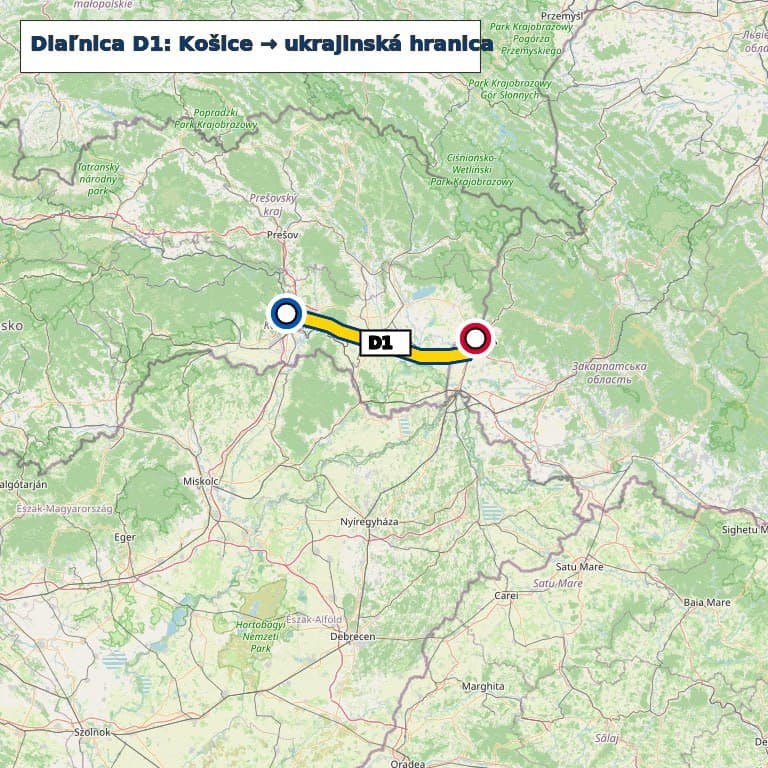
Short answer: not next year and not in five years, but the project has really moved from a dead point. The National diaľničná spoločnosť (National Motorway Company) has completed the procurement for preparing the environmental impact assessment (EIA) report for section D1 Bidovce – state border with Ukraine, writes Naše Košice. For Ukrainians who regularly travel between Košice, eastern Slovakia, and Ukraine, the essence is simple: a full motorway to the border is officially planned, but for trips in the coming years, still count time according to the current road and check current routes and travel.
What exactly happened now
This is a very early, though mandatory stage of a large road construction: EIA, that is environmental impact assessment. The contractor must prepare the report within 365 days; then there will be a final EIA conclusion, followed by permitting processes, and only after that NDS (National Motorway Company) can announce procurement for project documentation. Procedure details are already entered on Enviroportál.
Practical conclusion: “strategic project” does not equal “opening soon.” The government gave the section strategic investment status back in November 2024, but now the environmental-permitting part is ongoing, which in Slovak motorways often stretches for years.
What the route to Ukraine should be
The new segment from Bidovce to the border is planned to be 72.02 km long. According to project parameters, it will be a four-lane highway with seven grade-separated interchanges, two rest areas, and 24.8 km of noise barriers. The route should go through Dargov, Michalovce, and Sobrance to the state border with Ukraine.
There is one fundamental point: the feasibility study chose the option without a tunnel through the Dargov pass. For drivers, this potentially means a simpler but still mountainous section where winter weather and speed limits will matter. Exact geometry, bypass options, and land expropriation boundaries will be clarified during the EIA.
The official logic of the project is to connect eastern Slovakia with the west of the country and Ukraine by a high-speed road. Regions Zemplín, Vranov nad Topľou, Humenné, Snina, and Sobrance are specifically mentioned: they should get a proper exit to D1, and towns and villages along the current I/19 road should have less transit traffic.
What this will give Ukrainians in Slovakia
If you live in the east or often travel to Ukraine, the main benefit is a more predictable road without hour-long jams in settlements and fewer trucks currently crawling along I/19. For business, this is about logistics: warehouses, delivery, contractors, and seasonal trips between Košice, Michalovce, Sobrance, and the Ukrainian border will become easier only when not just one section but the entire corridor opens.
But planning life or contracts based on the “motorway to the border” right now is a bad idea. There is no reliable opening date for the eastern section yet; the EIA stage and a one-year report deadline exist. So for the next few years, reality will remain the same: D1 to Košice, then regular roads through eastern districts, queues at border crossings on some days, and dependence on weather in mountainous areas.
And what about the gap between Bratislava and Košice
The main Slovak axis D1 is being built in parallel. The most critical piece now is the Ružomberok bypass, the Hubová – Ivachnová section 14.92 km long with the Čebrať tunnel of 3.6 km. After delays due to a landslide, its opening is expected in September 2026; estimates say it will save drivers about 16 minutes, writes Štandard.
The second missing part is Turany – Hubová, about 13.5 km. Its construction is planned to start in 2027 and finish approximately in 2034. That is why the formula “about 30 km missing from Bratislava to Košice” will remain relevant for a long time: after the Ružomberok bypass opens, it will be easier, but a full continuous west-east motorway will not appear before the next decade.
What drivers should do now
Do not plan your trip east based on the “future D1.” Check the current road conditions, leave extra time for the section after Košice, and in winter separately check passability in the Dargov area. If you are going to the border, the decisive factor will often be not the motorway but the queue at the crossing and the condition of I/19.
For long-term plans — moving east, opening a warehouse, a logistics contract — follow the EIA stages and permits, not loud announcements. The fact now is: the direction to Ukraine is recognized as a priority, documents are moving, but asphalt has not yet started to be laid.