
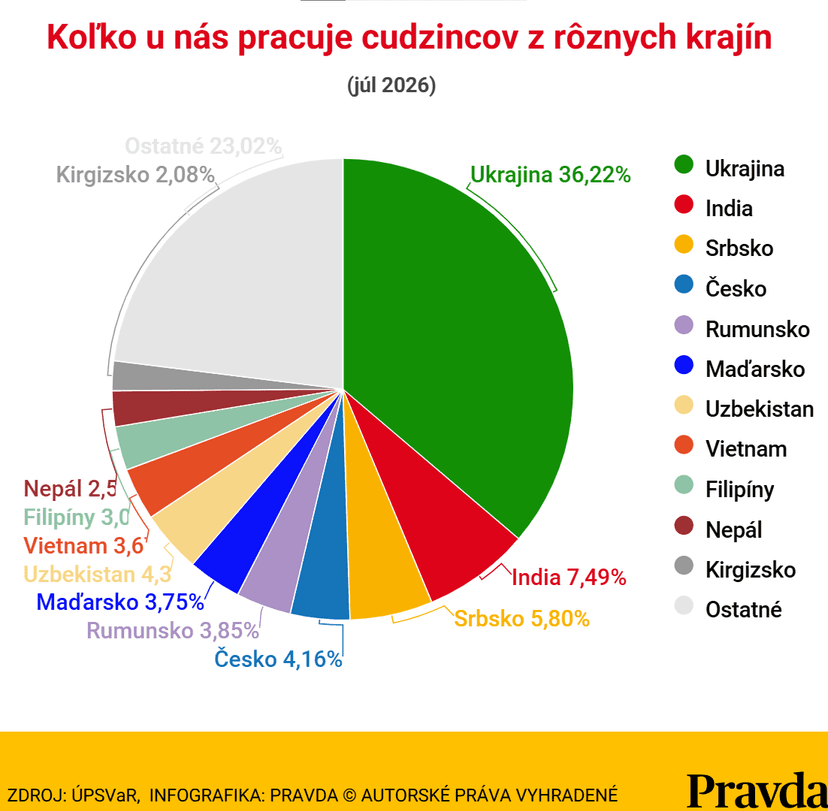
Slovakia’s industrial plants are increasingly reminiscent of an international airport or a UN meeting: alongside local workers at machine tools and on assembly lines, Serbs, Ukrainians, Indians, Filipinos, and Nepalese are also working. Due to the demographic crisis and an aging population, the number of Slovaks in factories is decreasing every year, so hiring foreigners has become the only way for businesses to maintain production.
According to the Ministry of Labor, more than 147,000 foreign nationals were officially employed in the country in July—that’s nearly 6% of the total workforce (2.6 million people). Although this figure has decreased slightly compared to June (by 3,800 people), it remains significantly higher than at the beginning of the year or in 2025 (when 129,000 foreigners were employed).
The geographic scope is expanding: from neighboring countries to Southeast Asia
The decline in the number of workers from traditional source countries (Ukraine, Romania, Serbia) is forcing companies to look for labor resources much further afield.
New source countries: According to the Ministry of Labor, the number of workers from Uzbekistan, the Philippines, Nepal, Kyrgyzstan, and Indonesia has increased significantly this year.
Key Sectors: In addition to industrial manufacturing, foreign workers are being hired in large numbers in logistics, construction, the service sector, as well as for technical and IT positions.
“The reason for hiring foreigners is simple—there is a physical shortage of local workers in many professions on the labor market, not because companies prefer foreigners,” explains Zuzana Rumiz, general manager of the recruitment agency ManpowerGroup Slovensko.
Slovaks Are More Tolerant Than Czechs: What Surveys Show
Despite concerns about cultural barriers or differences in work ethic, a study by the agencies Grafton and Gi Group revealed an interesting trend: Slovaks proved to be significantly more welcoming to foreign colleagues than residents of neighboring Czechia.
75% of Slovak employees have no reservations about colleagues of other nationalities.
More than 25% consider hiring foreigners a direct benefit for the company.
Only 6% of respondents complain about cultural differences, and only 9% fear losing their jobs due to competition.
By comparison, in the Czech Republic, only half of those surveyed view foreign colleagues positively or neutrally, while 14% complain about cultural differences. Experts attribute this to the fact that in the Czech Republic, foreigners make up 22% of the workforce (nearly 935,000 people), whereas in Slovakia this figure is significantly lower, which reduces social tension.
The Main Obstacle to Integration: Government Bureaucracy
While the private sector is actively investing in language courses, onboarding, and housing for new employees (51% of Slovak companies implement measures to support multicultural teams), the government continues to create administrative barriers.
Representatives of the Employers’ Association (AZZZ SR) and recruiters highlight the main problems hindering the labor market:
Long wait for residence permits: Procedures for granting and renewing residence and work permits at the immigration office drag on for months.
Bureaucratic red tape: Instead of being able to adapt quickly, workers are forced to gather dozens of documents and stand in long lines.
Lack of language and social infrastructure: Currently, only businesses and civil society organizations are working to integrate foreigners into local communities, without systematic support from the government.
Experts emphasize that bringing a worker to Slovakia is only one-third of the battle. If the government does not simplify bureaucratic procedures and speed up the work of immigration authorities, foreign workers will simply book a ticket to other EU countries, and Slovak companies will lose millions in investments.