

If you are pregnant, caring for a sick relative, or have a child in kindergarten or school, your visits to institutions in Slovakia have just decreased. From August 1, 2026, new electronic medical services were launched in the country: the doctor processes documents online, and government institutions receive them automatically, without your involvement.
The best part here, of course, is the money. Pregnancy data is now automatically sent to the Sociálna poisťovňa (Social Insurance Institution). At the beginning of the 13th week of pregnancy, the system itself starts processing pregnancy benefits, and 6 weeks before the expected delivery date — maternity benefits (materské). Paper applications, which previously had to be delivered in person, are no longer needed.
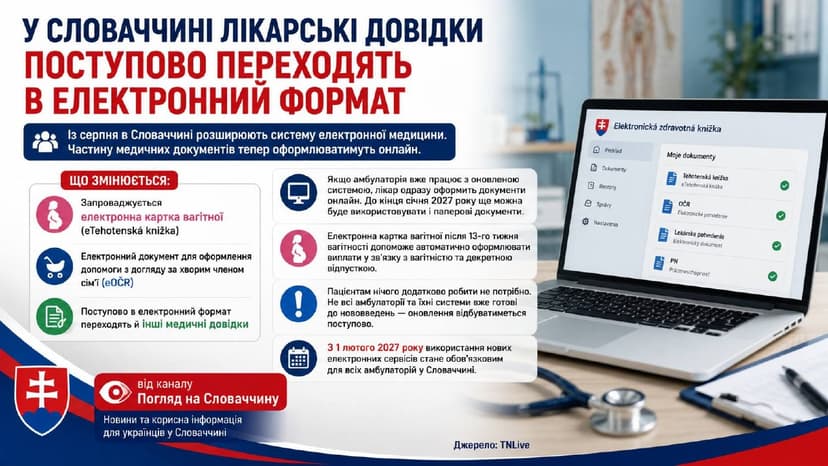
What exactly has changed
The new services operate within the state eZdravie system (electronic health care), managed by the National Center for Medical Information (NCZI). Since August 1, three things have been added:
eTehotenská knižka — electronic pregnancy card. The Gynekológ (gynecologist) manages it online, and the data automatically goes to social insurance for benefit payments.
eOČR — electronic certificate of care for a sick family member. It replaces the paper OČR certificate, which had to be taken to the employer and insurance.
ePotvrdenia — electronic excuses for schools and kindergartens. Parents no longer need to personally bring a certificate from the pediatrician to the educational institution.
The changes were implemented based on an amendment to law No. 153/2013 Z. z. on the national health information system. The start of the services was announced by NCZI on its website.
Why it does not work everywhere yet
The launch is not an on/off switch. Until January 31, 2027, there is a six-month transition period: medical facilities and software providers gradually update their systems. Until your doctor’s outpatient clinic is updated, you will still receive paper documents. They remain valid, so there is no need to worry.
Doctors themselves support digitalization but honestly say: not all outpatient clinics are technically ready. If you get a paper document at your next visit, it is not a refusal of the reform but just a queue for updating.
The new electronic services will become mandatory for all medical service providers from February 1, 2027. From then on, paper versions will gradually become a thing of the past.
You don’t need to do anything
For the patient, everything is simple: no applications, registrations, or additional steps are required from you. The doctor arranges everything on their side. The only thing worth doing is to check if your data in the patient card (full name, date of birth, insurance number) is correct because this data will be sent to social insurance for benefit payments.
This is not the first digital change in Slovak medicine this year. Since July 1, 2026, the eZapisovanie requirement came into force — medical services must be recorded in eZdravie, otherwise insurance companies will not pay the facility. And since April, the content of the electronic patient medical card has been expanded. Electronic prescriptions and sick leaves (ePN) are already working almost 100% — so Slovakia is steadily moving medicine online, as Trend writes.
For Ukrainians who work officially here and have Slovak insurance, this is purely a plus: less bureaucracy in Slovak, fewer questions about “where to take this paper.” Pregnant women get automatic payments without applications, and parents of schoolchildren avoid visits to school with certificates.