
The ad promised €1,200 — €926.51 came to the card. No one cheated anyone: Slovak employers name the salary in hrubá mzda (gross salary — before deductions). The difference in 2026 is €273.49 monthly, and it consists of only two payments, which are easy to calculate yourself.
Why are the salary in the ad and the amount on the card different numbers?
The employer agrees with you on hrubá mzda (gross salary — before deductions) — the amount before all deductions. The card receives čistá mzda (net salary). Between them are two different payments: mandatory insurance contributions and income tax. Contributions take 14.4% of gross. Tax is calculated from the remainder, and before it, the non-taxable part is subtracted from the base. Both payments are withheld by the employer; the employee does not go anywhere or transfer anything themselves.
From January 1, 2026, the employee's health insurance increased from 4% to 5%. The total contribution rate rose from 13.4% to 14.4% because of this. On an average salary, this is about €16 per month. The amount is small, but because of it, old calculators and articles show an inflated net: the difference between hrubá a čistá mzda in your contract is bigger than last year.
The amount in job ads in Slovakia is almost always written as gross. The word “netto” in the ad is rare and a reason to ask again at the interview which amount exactly is meant. Whether it is a lot for your profession is shown by average salaries by professions and regions.
How much exactly is deducted from salary in 2026?
From the gross of an employed worker, 14.4% goes: 5% for health insurance and 9.4% for social insurance. The social part is divided into four contributions: nemocenské 1.4%, starobné 4%, invalidné 3%, and poistenie v nezamestnanosti 1%. Rates are the same for all employees regardless of citizenship and type of residence, and you can check them in the Sociálna poisťovňa (social insurance institution) payment tables for 2026.
The first 14 days of sick leave are paid by the employer, from the 15th day Sociálna poisťovňa pays. From 2026 this limit shifted from 10 days to 14: two weeks of illness are now fully on the employer. Starobné poistenie forms pension insurance record, invalidné gives the right to disability pension, and the unemployment contribution gives the right to dávka v nezamestnanosti (unemployment benefit) after job loss.
Social contributions are calculated up to a maximum of €16,764 per month: anything above this amount is not subject to contributions. But health insurance has no ceiling at all; 5% is taken from any salary. Another change in 2026: exemption from contributions during sick leave, maternity, and care for a close person was canceled. If there is income for these days, contributions are paid on it. How much was really paid for you is visible in the insured person's individual account on the e-Služby portal of Sociálna poisťovňa.
19 or 25 percent — how is income tax calculated from salary?
For the vast majority of employees — 19%. But not from the entire gross. First, contributions are subtracted from gross, resulting in čiastkový základ dane (partial tax base). Then from it, nezdaniteľná časť základu dane (non-taxable part of the base) is subtracted: in 2026 this is €497.23 per month, or €5,966.73 per year. Only the remainder is taxed.
The 19% rate applies up to €3,665.28 base per month. Above that, according to financial administration rates, 25% starts — up to €5,029.10, then 30% up to €6,250.86, and 35% above that. The 30% and 35% bands appeared in 2026. The progression is banded: the higher rate applies only to the part of the base above the threshold; the rest remains at the lower rate.
The non-taxable part decreases with high income. The full €5,966.73 is received by those whose annual base does not exceed €26,083.13. Above that, the formula 14,661.11 minus one-third of the base applies, and at €43,983.32 the non-taxable part disappears completely.
The non-taxable part and child bonus are applied monthly by the employer only if you signed vyhlásenie (declaration — application for applying the non-taxable part and tax bonus). It is submitted to one employer, and in one month — only to one. If you did not sign the declaration, you pay up to €94.47 extra tax monthly and get this money back only in spring next year. For a year, this is up to €1,133.64, which lies with the state all year.
How much is left from €915, €1,611, €2,000, and €3,000?
Calculation conditions: full rate, signed vyhlásenie, no children, no disability. €915 is the minimum salary in 2026, €1,611 is the national average for Q1 2026 according to the statistical office.
Gross | Contributions 14.4% | Tax | Net |
|---|---|---|---|
€915 | €131.76 | €54.34 | €728.90 |
€1,611 | €231.98 | €167.54 | €1,211.48 |
€2,000 | €288.00 | €230.80 | €1,481.20 |
€3,000 | €432.00 | €393.44 | €2,174.56 |
Where does the figure €1,211.48 come from:
1,611 − 231.98 = €1,379.02 — partial base after contributions.
1,379.02 − 497.23 = €881.79 — base after non-taxable part.
881.79 × 19% = €167.54 — tax for the month.
1,611 − 231.98 − 167.54 = €1,211.48 — amount on the card.
From the minimum wage, 79.7% of gross remains in hand; from €3,000 — already 72.5%. The higher the income, the less the fixed non-taxable part matters: €497.23 is more than half of the minimum wage and only one-sixth of €3,000. Your actual pay slip may differ by a few cents because accounting programs round differently.
How to read your výplatná páska (pay slip) line by line?
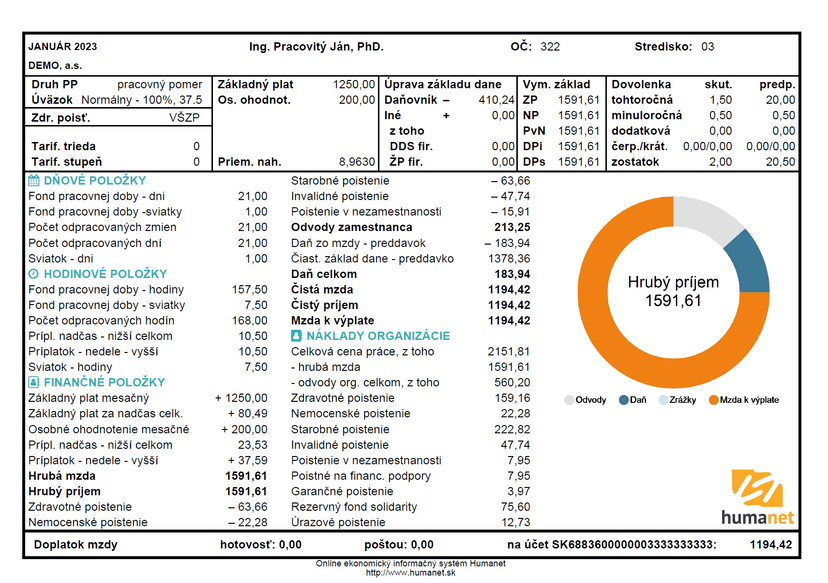
Výplatná páska (pay slip) is a monthly document where the employer shows how your salary is composed. Here is how the same €1,611 looks in it:
Line in pay slip | Rate | Amount | Where the money goes |
|---|---|---|---|
Zdravotné poistenie | 5% | €80.55 | your health insurance |
Nemocenské poistenie | 1.4% | €22.55 | Sociálna poisťovňa |
Starobné poistenie | 4% | €64.44 | Sociálna poisťovňa |
Invalidné poistenie | 3% | €48.33 | Sociálna poisťovňa |
Poistenie v nezamestnanosti | 1% | €16.11 | Sociálna poisťovňa |
Preddavok na daň | 19% | €167.54 | tax office, via employer |
Together these lines total €399.52, and gross is reduced by exactly this amount. Preddavok na daň is a tax advance, not the final payment: the summary is done once a year. Lines with extra payments and compensations are above and work in the opposite direction: they increase gross, from which the same percentages are then calculated. The meanings of other abbreviations in this slip are collected in the dictionary article výplatná páska.
What does daňový bonus (tax bonus) for a child give and who loses it?
Daňový bonus is added to the salary monthly and immediately increases the amount on the card. In 2026 it is €100 per child up to 15 years old and €50 per child from 15 to 18. The last month of accrual is the month in which the child turns 15 or 18 respectively.
Example with our numbers: an employee with €1,611 gross and one seven-year-old child receives €1,311.48 instead of €1,211.48.
The bonus has two ceilings. The first is percentage: the amount cannot exceed 29% of the partial base with one child, 36% with two, 43% with three, then 50%, 57%, and 64% with six or more. On the average salary, it does not apply: 29% of €1,379.02 is €399.91, much more than the bonus itself. This ceiling affects incomplete worked months and very low bases.
The second ceiling concerns higher incomes: when the monthly partial base exceeds €2,286 (about €2,670 gross), the bonus decreases by one-tenth of the excess. Two more conditions are easy to miss: the child lives with you in the same household, and at least 90% of your income has a Slovak source.
How much do you cost the employer?
Above your gross, the employer pays another 36.2%. Social contributions — 25.2%, and rates there are different: starobné for the employer is 14%, not 4% as for you. Also added are úrazové 0.8%, garančné 0.25%, and reserve fund 4.75%, which the employee does not have at all. Employer's health insurance is 11%.
A salary of €1,611 gross costs the company €2,194.18 per month, €2,000 — €2,724, and €3,000 — €4,086. That is, the employee takes €1,211.48 on the card, and the employer writes off €2,194.18 from their account. The gap is €982.70 monthly.
This explains offers like “part will be paid in envelope.” The arithmetic is obvious for the employer, but the employee pays for it: the unofficial part of the salary does not give paid sick leave, pension record, unemployment help, or income confirmation for bank or migration office.
All this math applies to an employment contract. In dohody (agreements outside employment relations), the set of contributions is different: it depends on the type of agreement and benefits, and this is a separate topic. In živnosť (živnosť — sole-trader licence — self-employment), contributions and tax are calculated by other rules, and there is a separate živnosť calculator.

Who will return the overpayment — ročné zúčtovanie or daňové priznanie?
If all year you had only income from employment, the annual account is closed by the employer, and you do not need to file a declaration. This is called ročné zúčtovanie (annual tax reconciliation): the employer recalculates your tax for the year fully and returns the overpayment.
The procedure for 2026 is:
By February 15, 2027, ask the employer in writing to do the recalculation and add documents — birth certificates of children, confirmation of paid contributions.
The employer performs the recalculation by March 31, 2027.
The employer issues a certificate of recalculation to you by April 30, 2027.
The overpayment is returned no later than when calculating the salary for April.
If you missed the request, you file daňové priznanie type A (tax declaration) yourself by March 31, 2027. Overpayment usually arises for three reasons: the declaration was not signed from January, you did not work all twelve months, or income was uneven. This path is explained step-by-step in the article about how to get back overpaid tax.
What else changes the amount on the card?
Extra payments for inconvenient hours are included in gross, so they are subject to contributions and tax equally with the rest of the salary. In 2026 the minimum is €2.6295 per hour for Saturday work, €5.259 per hour for Sunday, and €2.1036 per hour for night work. For work on a holiday, at least 100% of average earnings is due; for overtime — at least 25%. The full list is in the dictionary article about legal salary supplements.
The minimum salary €915 applies only to the first degree of job complexity. There are six degrees: €1,031 for the second, €1,147 for the third, €1,263 for the fourth, €1,379 for the fifth, and €1,495 for the sixth. The degree depends on the nature of the work; the employer does not choose it at their discretion and is not allowed to pay less than the set minimum.
The thirteenth salary has no benefits: it is taxed and subject to contributions equally with the regular salary. The exemption of the 13th and 14th salary from tax was valid until December 31, 2020, and its return as of August 2026 has not happened — it is still only a bill.
Check with accounting if your signed vyhlásenie is there: without it, you pay up to €94.47 extra tax monthly, and you will have to wait for the refund until spring. The last day to ask the employer for the annual recalculation for 2026 is February 15, 2027.