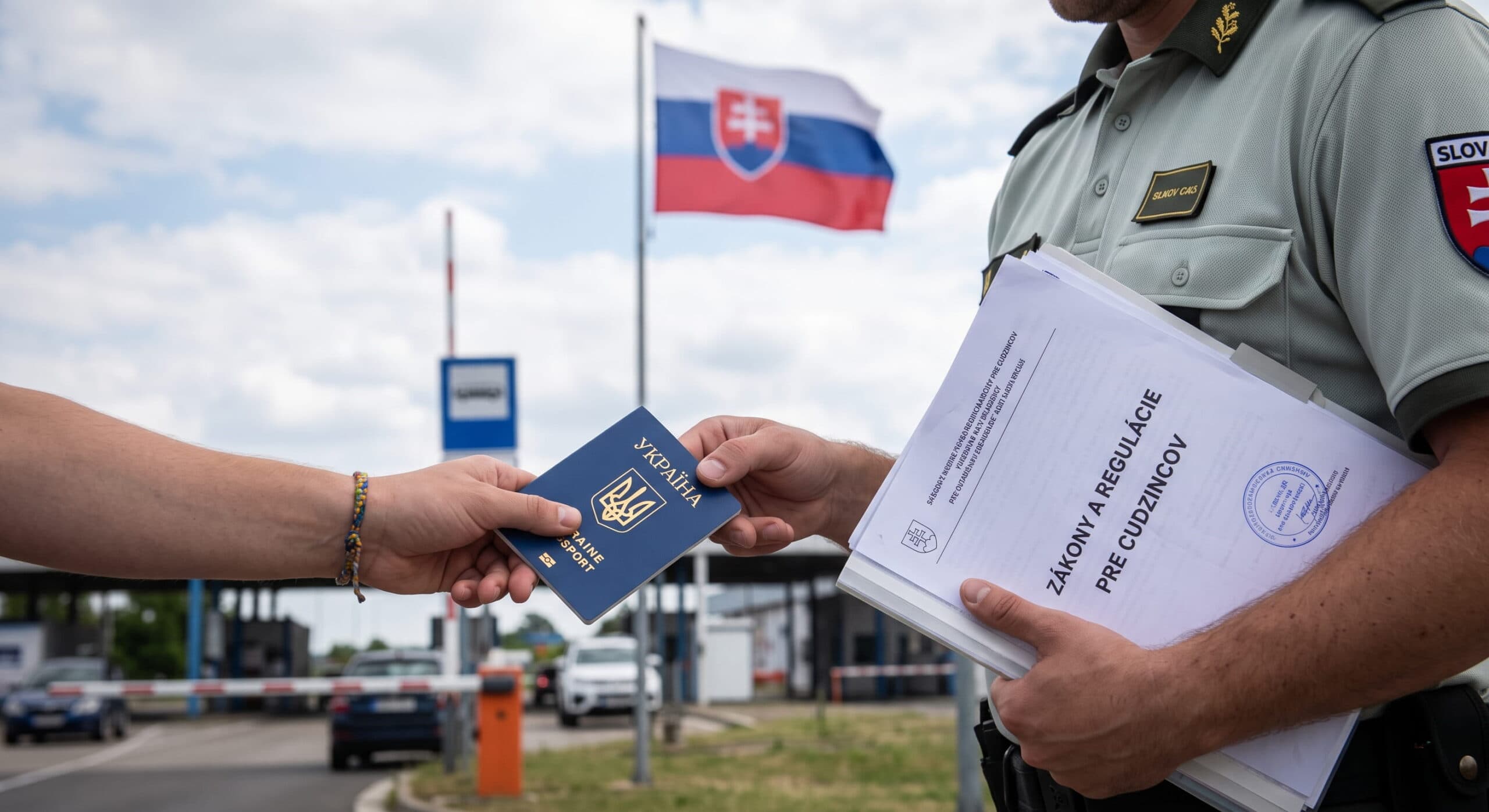

In the first half of 2026, Ukrainian citizens submitted 12 applications for international protection in Slovakia. Decisions in their cases were made 15 times, and none of them were about asylum: three were about additional protection, the rest were negative or suspended. And everyone who had temporary protection and submitted such an application lost it the same day.
Dočasné útočisko (temporary protection) Ukrainians received collectively, by decision of the EU Council and government decree, without reviewing each person's story. Asylum and additional protection are granted differently by the Migračný úrad (Migration Office of the Ministry of Interior of the Slovak Republic): after a personal interview and verification of what happened specifically to you.
How is asylum different from temporary protection?
Dočasné útočisko was introduced in Slovakia by government decree following the EU Council decision: it covers a whole group of people and does not ask what exactly happened to each. Medzinárodná ochrana (international protection) works the opposite way — the office studies the story of one person and makes a decision specifically about them. Within international protection, there are two different statuses: azyl (asylum) and doplnková ochrana (additional, or subsidiary, protection).
Since June 12, 2026, both are granted without a time limit. Previously, additional protection was given for one year and had to be extended; now the law on international protection explicitly states that both asylum and additional protection are granted na dobu neurčitú (for an indefinite period). Only the residence card is changed — it is valid for four years.
What we compare | Temporary protection | Asylum | Additional protection |
|---|---|---|---|
Who can apply | everyone covered by the EU Council and government decision | someone personally persecuted | someone facing serious harm at home |
How long the status lasts | until March 4, 2027; the EU Council has already extended it to March 4, 2028 | no time limit | no time limit |
Work during application review | allowed | forbidden for the first 6 months | forbidden for the first 6 months |
Where the person lives during review | in a camp for up to 60 days, then anywhere they want | in a camp; outside allowed but without support | in a camp; outside allowed but without support |
Family reunification | separate decision on protection for relatives | separate status under § 32 | separate status under § 33 |
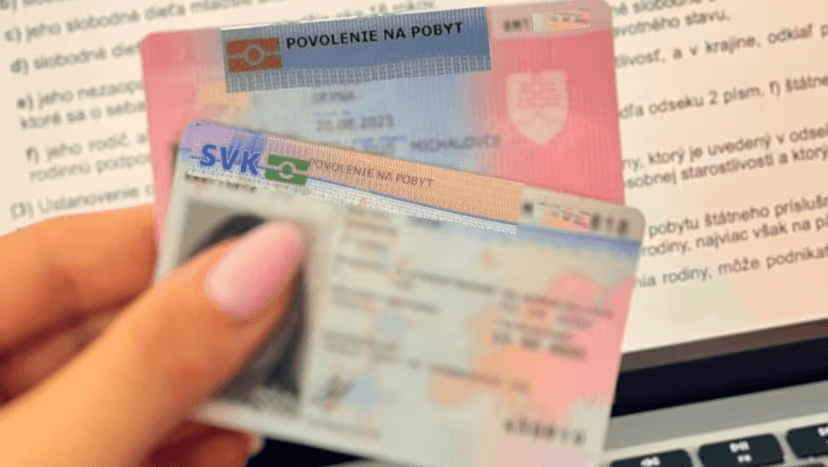
Document held | certificate of tolerated stay marked «DOČASNÉ ÚTOČISKO» | residence card for 4 years | residence card for 4 years |
If you are just figuring out which status suits you, start with the general map. We collected it in the article about options for Ukrainian citizens’ stay in Slovakia.
Who can get asylum, and who will get additional protection?
The difference is what exactly the state protects you from. Asylum is granted to someone who meets the EU refugee recognition conditions or who is persecuted in their home country for exercising political rights and freedoms. Additional protection is for someone who faces vážne bezprávie (serious harm) in their homeland, even if there is no personal persecution. People searching write “political asylum,” but cases where danger comes from war, not persecution of a specific person, usually go through additional protection.
The applicant does not choose here. The same case can end with either of the two statuses, and the law provides for this: if a person is denied asylum, the authority must decide by the same decision whether to grant additional protection instead.
Besides these two, there are three national statuses: asylum for humanitarian reasons, asylum for family reunification, and additional protection for family reunification. The last two are granted to a family member with the written consent of the person with status.
And a terminology trap. In everyday speech, people say utečenec — refugee, escapee. In decisions and documents you will hold, it will say azylant. It is the same status, just look for the second word in the papers.
How to apply for international protection?
The application is not sent by mail or submitted online. Everything starts with a personal visit to the police department.
Declare your intention. The law calls this prejav vôle — expression of will. The police officer records the application on an official form.
Registration and biometrics. The police take the foreign passport or other ID and issue a confirmation, and also take biometric data. Fingerprints are taken from everyone aged six and older.
At registration, a temporary applicant ID valid for 30 days is issued. The full ID is processed by the office within five working days from application submission, and its validity is up to one year.
Transfer to a camp. If the case is not transferred to border procedure and the person is not detained, the police promptly organize transport to the záchytný tábor (reception camp).
The last step is a personal interview with an authorized office worker; it may be repeated if needed. Since June 12, 2026, the conversation is audio recorded, with prior warning, and the recording is attached to the asylum case.
If the person does not speak Slovak, an interpreter (tlmočník) is invited to the procedure, paid by the state. Free legal advice is an obligation of the ministry, not a service by agreement: it must be provided in a language the applicant understands, including group or video consultations.
How long to wait for a decision and where does the person live all this time?
The office makes a decision within four months from when the applicant provided data, and this period can be extended by up to four more months. In border procedure, decisions are made within six weeks from registration, in more complex cases — within eight; including appeals, according to the ministry, such a case should fit within 12 weeks, exceptionally 16.
This is where it is easy to find outdated numbers. Guides written before June 12, 2026, name six months — this was the norm of the repealed 2002 asylum law. As of early August 2026, these six months are still on the Slovak UNHCR page. If you see such a number — the page was not updated.
At first, the person goes to the záchytný tábor, then to the pobytový tábor (residence camp). Living outside the camp is not prohibited by law: you must notify the office in writing in advance. But then the state stops supporting: for absences longer than one day, no housing, food, or pocket money is provided. There are only four such facilities.
Facility | Address | Who stays there |
|---|---|---|
Záchytný tábor Humenné | Mierová 100, 066 01 Humenné | everyone who just applied |
Pobytový tábor Opatovská Nová Ves | 991 07, post Slovenské Ďarmoty | applicants during case review |
Pobytový tábor Rohovce | 930 30 Rohovce | applicants during case review |
Integračné stredisko Zvolen | Jesenského 13, 960 01 Zvolen | those who already received status |
The camp provides housing, food or money for food, basic hygiene items, and pocket money. All free until the ministry decides the person’s financial situation allows partial payment. The law does not specify the exact pocket money amount — it is set by internal rules of each camp, so ask locally.
What does a person with temporary protection lose if they apply for asylum?
Among the grounds for which dočasné útočisko ends, there is a point: if an odídenec (Odídenec - a person with temporary protection) requested international protection in Slovakia. The rule applies from the very fact of application submission, before any substantive decision.
The law closes these doors from both sides. Proceedings for temporary protection will not even start if the applicant is already an applicant for international protection, an asylum seeker, or a person with additional protection. And ongoing proceedings are suspended as soon as the person requests international protection. The two statuses cannot coexist.
The right to apply does not disappear. EU Council Directive 2001/55/EC explicitly says persons with temporary protection must be able to apply for asylum at any time. The same directive allowed member states to separate the two statuses in time, and Slovakia used this option.
There is also a safeguard. Article 19(2) of the directive requires: if after reviewing the application the person is not granted refugee status or other protection, the state must allow them to continue using temporary protection — until the end of the general protection period. But neither the law nor the directive describes the procedure itself: whether the status returns automatically or the application must be submitted again. This is a question asked to the Migration Office before applying, not after.
The practical difference felt immediately is work. An applicant for international protection has no right to enter employment relations for the first six months from registration, and entrepreneurship is forbidden for the entire procedure. After six months, work is allowed but not for everyone: the law names exceptions — application rejected as manifestly unfounded, decision made to transfer to another EU state, court did not grant suspensive effect to appeal. This prohibition does not apply at all to an odídenec (person with temporary protection): the law applies only the first four paragraphs of that article to them, deliberately leaving out the fifth, which forbids work.
If you are thinking not about applying for asylum but about leaving temporary protection, that is a different scenario. We wrote about it separately in the article about closing temporary protection.
What does the status give after a positive decision?
First of all, stability. The status is indefinite, and among the grounds for asylum termination, expiration of term is not listed at all: Slovak or other EU citizenship, written refusal of status, death, withdrawal of status, and granting protection by another EU country. The police issue the residence card for four years and then replace it.
Six calendar months from the date of status granting, medical insurance is paid by the state — it becomes the payer of contributions for the asylum seeker and the person with additional protection.
But money at the start — this is where Ukrainian readers will be disappointed. The law provides a one-time aid of 1.5 subsistence minimums (if the person completed a basic cultural orientation course) and integračný príspevok (integration allowance) — 1.75 subsistence minimums for six consecutive months, with a strict deadline for application: 60 days from status granting. But a separate paragraph excludes from both payments those who previously had temporary protection, residence permit, or permanent residence in Slovakia. An odídenec who received asylum will see neither one-time nor integration aid. Slovak language courses, cultural orientation courses, social and psychological counseling remain — this exception does not affect them.
Those with additional protection, asylum for humanitarian reasons, or asylum for family reunification who do not have their own valid passport receive a cudzinecký pas (foreigner’s passport) — a travel document for leaving Slovakia and returning; the police issue it for two years. After a few years, a path opens further to long-term residence and citizenship: we analyzed how it looks in the article about permanent residence and citizenship in Slovakia.
How many Ukrainians really get asylum in Slovakia?
Practically no one. In 2025, Ukrainian citizens submitted 40 applications. Decisions were made in 37 cases: no asylum, 13 additional protections, 3 negative, 21 proceedings suspended. In the first half of 2026 — 12 applications and 15 decisions: again no asylum, 3 additional protections, 7 refusals, 5 suspended cases.
So the typical positive result for a Ukrainian is additional protection, and even that happens less often than cases end with nothing.
The scale is even clearer over the long term. According to Migration Office statistics, from 2010 to August 30, 2026, Slovakia received 5,624 asylum applications from citizens of all countries. Asylum was granted 505 times, additional protection 710 times.
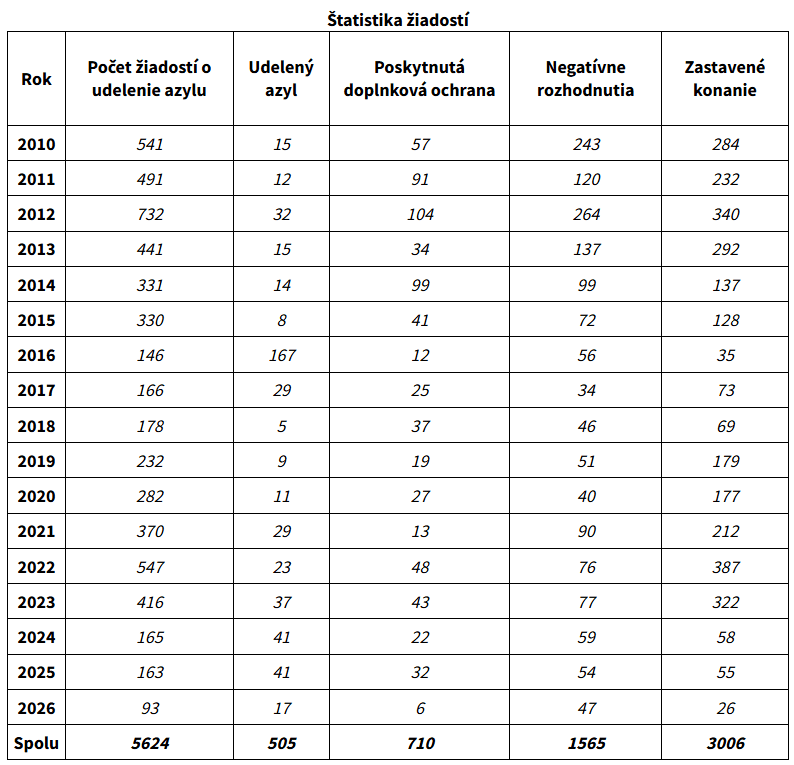
(data updated monthly)
Compare this with hundreds of thousands of Ukrainians living in the country with temporary protection: asylum is a narrow path for those with a personal persecution story.
What to do if asylum was denied?
There is no ordinary appeal here, and this is the first surprise. Against a decision rejecting the application as inadmissible, unfounded, or manifestly unfounded, and against a decision withdrawing status, you cannot file either a rozklad or a motion to reopen proceedings. The only way is a správna žaloba (administrative lawsuit) to court. People search online for the word odvolanie (appeal) and complaint form, but procedurally this is a lawsuit to court, not a complaint to a higher authority.
The second feature is stricter: in some cases listed separately by law, filing a lawsuit does not suspend the decision. It remains in effect until the court cancels it.
Deadlines in border procedure are named explicitly: lawsuit must be filed within seven days of decision delivery, court decides within 30 days, and suspensive effect is decided within five days of filing the motion. For other cases, the deadline is taken from the instruction printed in the decision text. Do not rely on other numbers from forums.
Someone still has to write the lawsuit. Along with the new law, free legal aid rules were rewritten: Centrum právnej pomoci (Legal Aid Center) handles asylum cases after a negative decision if the person is in financial hardship, has no chosen representative, and the case is not clearly hopeless.
Where to get consultation before applying?
The Migration Office of the Ministry of Interior of the Slovak Republic accepts at Pivonková 6 in Bratislava, phone +421 2 4341 4775. Free legal aid in the procedure is organized by the ministry itself, and before applying, consultations are held at the International Organization for Migration and Liga za ľudské práva — legal consultations there are by appointment. We wrote about free help for migrants in the article about IOM Centrum, and meanings of Slovak terms from decisions can be checked in our Slovak terms dictionary.
First consultation, then application — in this order, because there is no turning back: temporary protection ends on the day of application, not on the day of decision.