

Wage levels in Slovakia remain among the lowest in the European Union. According to a new analysis by the French Institut économique Molinari, based on calculations by the auditing firm Ernst & Young, the country ranked second to last among all EU member states in terms of average annual full-time wages, ahead of only Bulgaria.
This is confirmed by an analysis from the European Commission and the EU’s statistical office, which assesses average labor costs and employee income levels across Europe.
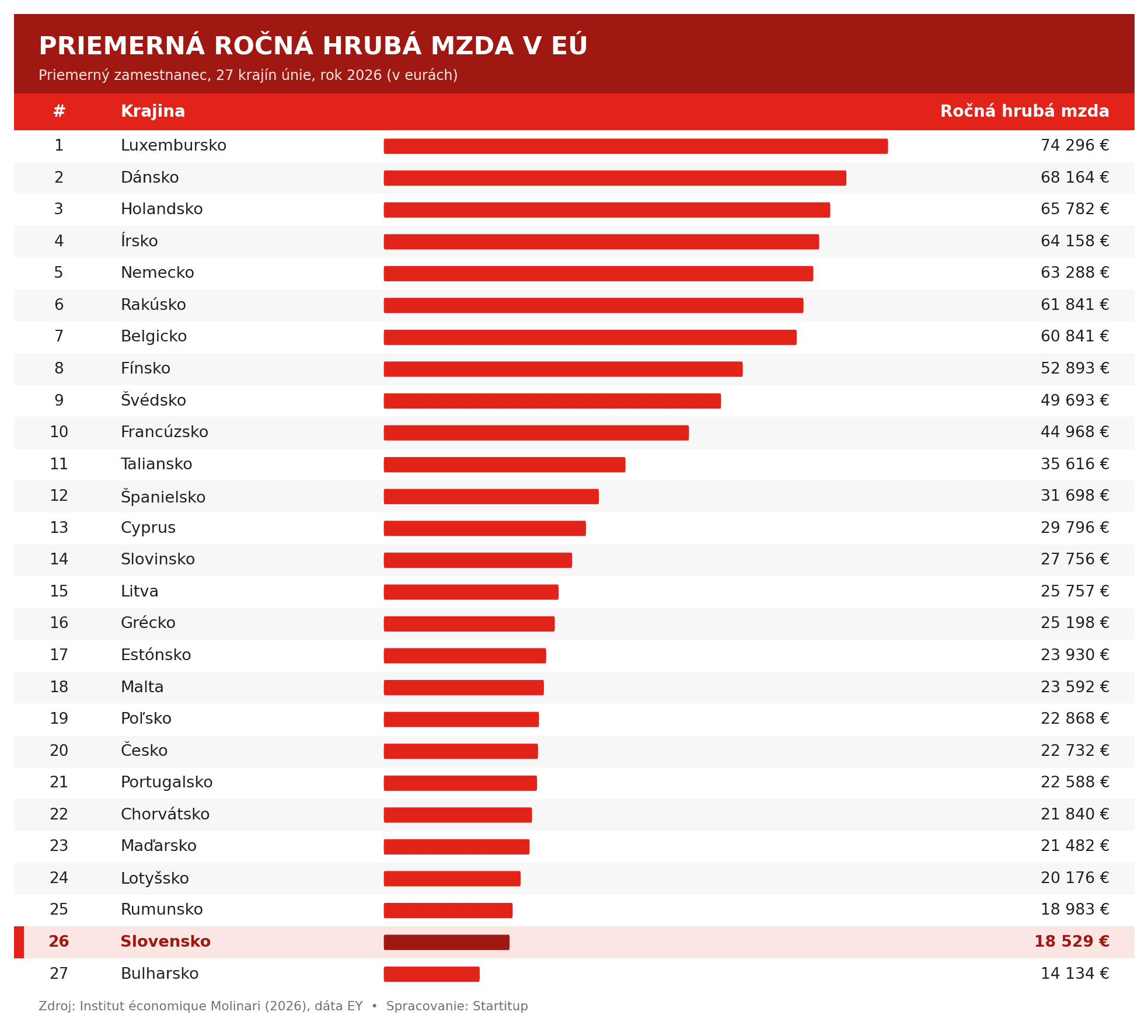
How wide is the gap?
According to published data, the average adjusted full-time wage in Slovakia is approximately 19,000 euros per year (before taxes and deductions).
By comparison, the average across the European Union is over 37,800 euros per year, which is nearly double the Slovak figure.
The highest incomes in the EU are found in Luxembourg, where the average annual salary is an impressive 75,600 euros. Thus, working in similar full-time positions, residents of Luxembourg earn an average of 55,767 euros more per year than workers in Slovakia.
Who are the leaders, and who are the laggards?
Top EU countries with the highest annual incomes for citizens:
Luxembourg — €75,600
Denmark — €68,250
Ireland — €58,680
At the bottom of the ranking, alongside Slovakia, are neighboring countries in Central and Eastern Europe, as well as the Baltic states. However, even most of the region’s neighbors show better results:
Czech Republic — about €23,400 per year
Poland — about €20,500 per year
Slovakia — €19,000 per year
Bulgaria — at the bottom of the list with approximately €13,500 per year
Why is this happening, and what does it mean for the economy?
Experts note that this significant gap is driven by several factors: the structure of the Slovak economy, which has a high share of low-value-added manufacturing, slower growth in labor productivity compared to Western Europe, as well as a restrained policy on wage increases in both the private and public sectors.
However, assessing well-being solely based on the amount in euros is misleading. Economists note that real purchasing power (parita kúpnej sily) remains an important factor—that is, how many specific goods, services, or square meters of housing a person can actually purchase with their salary.
According to Eurostat, when the situation is compared taking local prices into account, the country’s position looks somewhat better. Based on this index, the country outperforms not only Bulgaria but also a number of other countries, such as Latvia, Estonia, and Hungary. Since food, basic services, and utility bills are sometimes lower here than in Western Europe, the disparity is not felt as acutely in everyday life, although it does significantly limit opportunities for savings.